
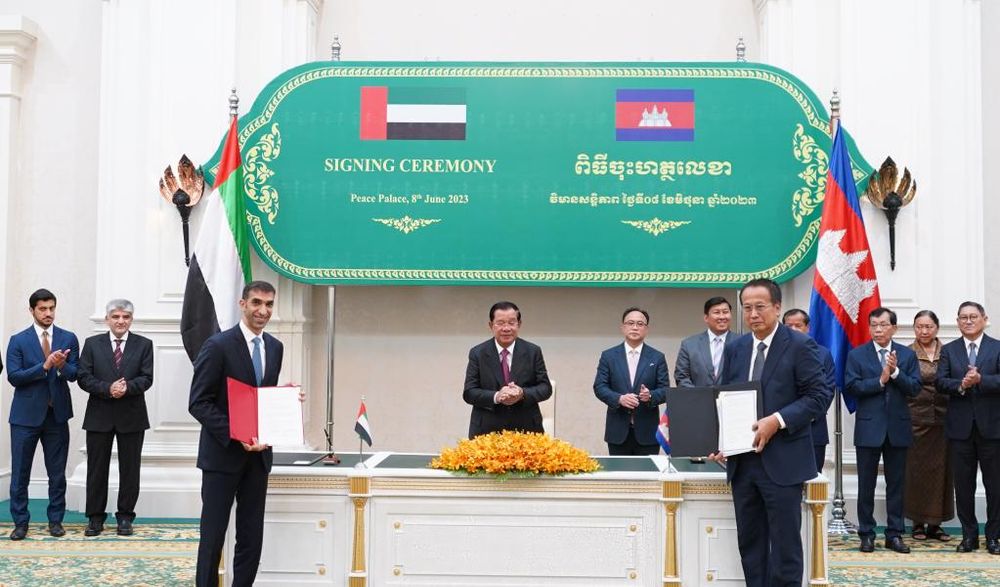
Five years ago, the United Arab Emirates made a quiet but consequential decision: rather than waiting for the multilateral trade system to deliver results, it would build its own. The launch of the Comprehensive Economic Partnership Agreement programme (CEPA) in September 2021 was the first move. What has followed is one of the most aggressive trade diplomacy campaigns of the decade.
By mid-2026, the UAE had concluded 37 CEPAs, a figure now updated to 38, with 18 already in force and more scheduled to activate in the coming months. The geography of these agreements tells its own story. It spans India to Indonesia, Kenya to Chile and Ukraine to Malaysia. The UAE has methodically stitched together a trade network that now spans virtually every major region of the global economy.
The numbers emerging from the programme are striking. In the first half of 2026, the UAE’s non-oil foreign trade reached approximately US$527.4 billion, while non-oil exports climbed to around US$123.2 billion. For context, non-oil exports increased by more than 45% in 2025 alone, indicators that are particularly significant as the UAE seeks to link its trade agreements with increased export capacity across the industrial sector. These are not coincidental figures. They reflect a deliberate policy of using market access as a lever to pull domestic production up the value chain.
CEPAs form part of a broader framework aimed at strengthening the UAE’s position within global trade and supply chains, leveraging its advanced logistics infrastructure, ports and free zones, as well as its ability to connect Asian, African and European markets. Dubai and Abu Dhabi are positioning themselves as the indispensable node between hemispheres. They aim to be a place through which goods, capital, and services transit on their way between the Global South and the industrialised world.
The India partnership remains the clearest proof of this concept. The UAE-India CEPA significantly contributed to the advancement of trade, with bilateral exchanges increasing from US$73 billion to US$84 billion year-on-year, registering a growth of 16%. Non-oil trade between the two countries reached approximately US$29.3 billion in the first half of 2026 alone. What began as a bold experiment has become the template. The question is no longer whether CEPAs work, but rather how fast the UAE can replicate the model.
Africa is where that replication becomes most consequential. In 2026, the UAE’s CEPA programme in Africa is no longer just a trade-policy headline. It is becoming a practical instrument to reshape economic relationships, deepen supply chains, and lock in long-term investment pathways across strategic sectors including logistics, agriculture, aviation, clean energy, and services.
Kenya, whose parliament has engaged the CEPA agreement through its ratification process, is being treated as a serious economic instrument rather than a symbolic handshake. Kenya’s strategic value is clear, in that, it is a regional logistics and aviation hub, a major services economy in East Africa, and a gateway into wider regional markets. The Gulfood360 Africa platform, anchored in the Kenya-UAE CEPA, is designed to connect Kenyan and African food producers directly to global buyers, a signal that the agreement is already generating commercial architecture, not just political goodwill.
The approach reflects a deliberate effort to avoid excessive dependence on a small number of trading partners, with agreements across major consumer markets, manufacturing centres, agricultural exporters and emerging economies. In July 2026, the UAE and Canada concluded negotiations in the shortest timeframe recorded under the programme, with bilateral trade between the two countries reaching approximately US$4.2 billion in 2025, representing growth of 21% compared to 2024.
Not everyone is celebrating without reservation. Analysts note that African governments must approach these agreements with clear industrial strategies. As one industry executive was quoted saying in a recent assessment of Gulf-Africa investment dynamics, the risk is that the agreements become import-export platforms rather than genuine industrialisation catalysts, with African raw materials continuing to flow outward for processing elsewhere.
That tension is the central challenge sitting beneath the impressive headline figures. The UAE has built the machine. The more important question for Africa, for Asia, for the smaller economies now joining the network, is whether preferential access translates into productive capacity, or whether it simply reshapes the direction of dependency. The answer will be written not in the text of the agreements, but in the factories, logistics corridors, and value chains that either emerge from them or don’t.
Written by:
*Dr Iqbal Survé
Past chairman of the BRICS Business Council and co-chairman of the BRICS Media Forum and the BRNN
*Chloe Maluleke
Associate at BRICS+ Consulting Group
Russia & Middle East Specialist
**The Views expressed do not necessarily reflect the views of Independent Media or IOL.
** MORE ARTICLES ON OUR WEBSITE https://bricscg.com/ (https://bricscg.com/)
** Follow @ (https://x.com/brics_daily)brics_daily (https://x.com/brics_daily)on Twitter for daily BRICS+ updates and instagram @brics_daily (https://www.instagram.com/brics_daily?igsh=bmhvbTd0YzA4a2wx)