
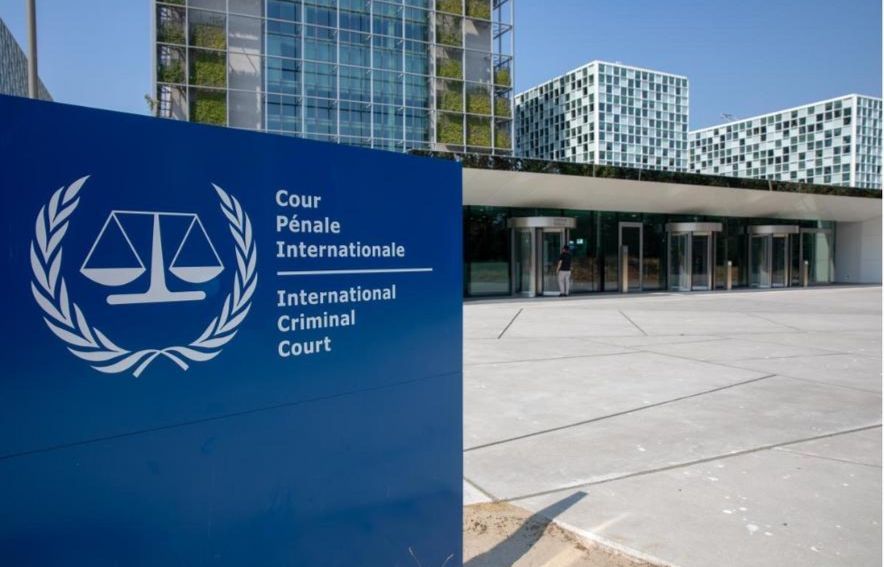
On Tuesday, the United States sanctioned a Japanese judge and a Senegalese lawyer. Their crime? Doing exactly what they were appointed to do. If that sentence does not stop you, read it again.
Tomoko Akane, President of the International Criminal Court, and Senior Trial Lawyer Abdoulaye Seye now find themselves barred from entering the United States and cut off from the American financial system. US Secretary of State Marco Rubio offered the justification without a flicker of self-awareness, stating that these individuals had “participated in efforts to investigate officials from countries that had not consented to ICC jurisdiction.” He said this as though it were damning. As though a court prosecuting atrocities should first seek permission from the governments whose officials committed them. There is a word for that logic. It is called impunity, and Washington is currently its most powerful advocate.
To understand why this matters beyond the immediate headlines, it helps to zoom out. The International Criminal Court was not dreamed up by idealists in a vacuum. It was built in the wreckage of the twentieth century, after Nuremberg, after Rwanda, after Srebrenica, on a single hard-won conviction: hat some crimes are so grave that the world cannot simply look away because the perpetrators happen to control a government. The United States did not just tolerate this idea. It championed it. American prosecutors stood at Nuremberg. American diplomats shaped the Rome Statute negotiations. And then, when the court began doing exactly what it was designed to do, Washington decided the experiment was over.
The proximate cause to this is Israel. The ICC issued an arrest warrant for Prime Minister Benjamin Netanyahu over the conduct of the war in Gaza. That warrant, whatever one thinks of its merits, was issued through a legitimate legal process by an independent judicial body. The appropriate response from a government that disagreed was to challenge it through legal channels, to make arguments, to engage. Instead, the Trump administration chose to sanction the judges. It is the legal equivalent of shooting the referee and then claiming the match was unfair.
Reducing this to the Israel question however misses the architecture of what is actually being built. On the 7th of January 2026, the United States announced its withdrawal from 66 international organisations, including 31 entities within the United Nations system. Among them, the UNFCCC, the IPCC, the WHO, and UNESCO, indicating a demolition project. Each withdrawal follows the same template: declare the institution corrupt or politicised, defund it, and dare the remaining members to hold it together without American money or participation. The US contributes roughly 18% of WHO funding, which meant its departure directly threatens the agency’s capacity to respond to tuberculosis, HIV/AIDS, and the next pandemic. The people who will die from that gap will not be American. They will be African, Asian, South American. They will be the people these institutions were most designed to protect.
What is perhaps most revealing is the selectivity. The Trump administration does not object to international institutions as a matter of principle. It seems to objects to international institutions that produce outcomes it dislikes. When the ICC indicted Vladimir Putin for war crimes in Ukraine, Washington said nothing. When it turned its attention to Netanyahu, the sanctions began. The principle being articulated, whether Rubio admits it or not, is straightforward: international law is a tool to be wielded against adversaries, not a framework that binds allies.
The rest of the world has been largely silent. 79 ICC member states issued a statement expressing concern. The European Union expressed support for the court’s independence. The UN Human Rights Chief called the measures deeply corrosive of good governance. None of it has moved Washington an inch. The reason is not hard to find. Most governments that depend on the ICC also depend on the United States for various reasons, such as defence arrangements, trade relationships or dollar system access. The power asymmetry is so total that what looks like cowardice is, for many smaller states, simply arithmetic. This is the genius of the approach: Washington has spent decades constructing a web of dependencies so dense that challenging it carries existential risk for most of its members. The cage was built slowly, so that by the time people noticed the bars, the door was already locked.
The longer-term consequences of all this are not yet fully visible, but their shape is becoming clear. Russia has already issued its own arrest warrants for ICC officials in retaliation for the Putin indictment, a direct mirror of Washington’s behaviour, justified by Washington’s precedent. China watches and recalibrates. Smaller authoritarian governments note carefully that sanctions against judges are now an acceptable diplomatic instrument. The norm being established is not American exceptionalism, but it is the principle that any state powerful enough to punish international institutions for inconvenient rulings may do so freely. The ICC survives today. What it will look like in a decade, after years of sanctions, defunding campaigns, and pressure on member states to withdraw, is a genuinely open question. The US has stated its commitment to using all appropriate diplomatic, political, and legal instruments to block ICC investigations. This is significant because they did not say reform them or not engage them, but rather block them. Permanently.
For South Africa, none of this is abstract. This country helped negotiate the Rome Statute. Our Constitution draws on the same body of international human rights law now under assault. The African continent has had a complicated relationship with the ICC, the accusations of selective prosecution against African leaders were not without foundation but the answer to a flawed court was never supposed to be a sanctioned one. The answer was reform, engagement, pressure from within. What Washington is doing instead is burning the institution to the ground and calling the smoke democracy. The judge being sanctioned this week is a Japanese woman who took an oath to uphold international law and kept it. The man signing the executive order has taken an oath too. The difference is which one is honouring theirs.
Written by:
*Chloe Maluleke
Associate at BRICS+ Consulting Group
Russia & Middle East Specialist
**The Views expressed do not necessarily reflect the views of Independent Media or IOL.
** MORE ARTICLES ON OUR WEBSITE https://bricscg.com/ (https://bricscg.com/)
** Follow @ (https://x.com/brics_daily)brics_daily (https://x.com/brics_daily)on Twitter for daily BRICS+ updates and instagram @brics_daily (https://www.instagram.com/brics_daily?igsh=bmhvbTd0YzA4a2wx)