
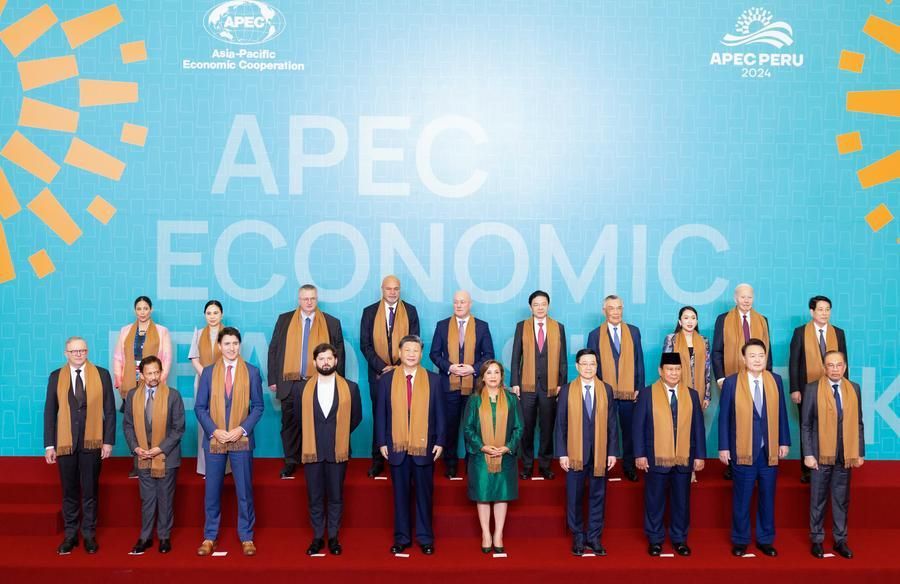
The word “Yalta” has returned to the commentary with a familiar shudder. A possible meeting between Xi Jinping, Donald Trump and Vladimir Putin on the margins of the Asia-Pacific Economic Cooperation (APEC) summit in Shenzhen on 18 and 19 November has been cast as three powerful men carving up the world over the heads of everyone else. The anxiety is understandable. It is also revealing, because the analogy rests on assumptions that deserve more scrutiny than the summit itself.
Start with what Yalta was. In February 1945, three victors of a shared war met to settle a shared aftermath. They had a common enemy, a common timetable and, crucially, the material power to redraw frontiers. None of those conditions exists in Shenzhen. As the political scientist Wen-Ti Sung has observed, there is no single adversary to unite the three leaders as Nazi Germany once did. Their agendas barely overlap. Moscow wants Ukraine at the centre, Washington has pressed for nuclear weapons and the Iran war, and Beijing has said little about either. A grand bargain requires a shared problem. This is a photograph in search of an agenda.
The more interesting question is why the Yalta frame has so much purchase. The answer, I think, is that it assumes the story of the twentieth century was written in a handful of rooms in Europe. For much of the world, that was never quite true. Yalta’s legacy was not only Soviet dominance in Eastern Europe. As the Singapore-based scholar Chong Ja Ian has noted, the settlement that followed opened a path to the Korean and Indochina wars, and to conflicts and insurgencies across Asia, Africa and Latin America. The cost of great-power bargaining was paid far from the negotiating table, and often by people who were not consulted. To those populations, the alarm now being sounded in European capitals has a certain familiarity, though not the one Europeans intend. Being decided about, rather than decided with, is an old experience for much of the Global South.
That does not make Ukrainian and European fears frivolous. President Zelensky is right to worry about a format that treats a war on his territory as a bargaining chip, and the Russian delegation’s questioning of Europe’s place in further talks does nothing to calm those nerves. But it is worth noticing where the discomfort is coming from. Beijing has repeatedly said that Europe should be at the table on Ukraine. Germany’s president, Frank-Walter Steinmeier, reports that President Xi bristled when trilateral talks on the conflict were mooted, insisting that this is a European matter in which Europeans must be present. One can doubt Beijing’s motives, and a state that calls itself a champion of multilateralism has its own interests in doing so. Yet the practical effect is that the party most often cast as architect of a new carve-up is, on this specific point, resisting one.
This is where analysis must part company with narrative. The convenient story has three strongmen dividing the spoils. The more plausible one has three governments with incompatible priorities, one of which has a long-standing doctrinal objection to the very logic of spheres of influence. China has opposed that logic since the outset, and it also has a reputational stake in not being seen to preside over a second Yalta. Hosting the meeting on its own soil gives it the stage but also the exposure. If Beijing wants to be taken seriously as an advocate for sovereignty and international institutions, it will have to behave accordingly, and observers across the developing world will be watching whether it does.
The same is true of Washington, and here the picture is less comfortable. The reassertion of American primacy in the “Western hemisphere”, including the seizure of Venezuela’s president in January, has already unsettled Latin America, where the memory of spheres of influence is not an abstraction. A Washington that insists on its own backyard while negotiating over others’ will find it hard to claim the language of a rules-based order. Taiwan, as Sung points out, will draw its own conclusions: if one partner can be set aside for convenience, so can another. That is a sober reading, and it applies to every state that has relied on a great power’s promises.
So what could actually come out of Shenzhen? Probably very little of consequence. Analysts expect modest results at best: crisis hotlines, perhaps cooperation on counter-terrorism, public health or climate. The contested files, trade and the technology race between Beijing and Washington, nuclear arms control, and the future of Ukraine, are each stuck on positions that a photo opportunity will not shift. China’s long-held view that the United States and Russia must cut their enormous arsenals before it discusses its own is not going to be reversed over a single lunch. Piecemeal horse-trading is in, a grand bargain is out.
The real significance may lie elsewhere, in what the meeting normalises. A trilateral format, even a fruitless one, establishes that the three can be convened and that others can be left outside. Smaller states, from Europe to Africa to South-East Asia, should take that as a prompt to build their own coalitions rather than wait to be consulted. Beijing could do something constructive by using the summit to insist on European inclusion and on the primacy of multilateral bodies, which would, as one Chinese scholar suggests, open a new channel between China and Europe.
Yalta is a poor guide to Shenzhen. A better one is the question the analogy hides: who gets to be in the room, and who is merely discussed? That was the problem in 1945, and it remains the problem now, whoever is hosting.
Written by:
*Chloe Maluleke
Associate at BRICS+ Consulting Group
Russia & Middle East Specialist
**The Views expressed do not necessarily reflect the views of Independent Media or IOL.
** MORE ARTICLES ON OUR WEBSITE https://bricscg.com/ (https://bricscg.com/)
** Follow @ (https://x.com/brics_daily)brics_daily (https://x.com/brics_daily)on Twitter for daily BRICS+ updates and instagram @brics_daily (https://www.instagram.com/brics_daily?igsh=bmhvbTd0YzA4a2wx)