
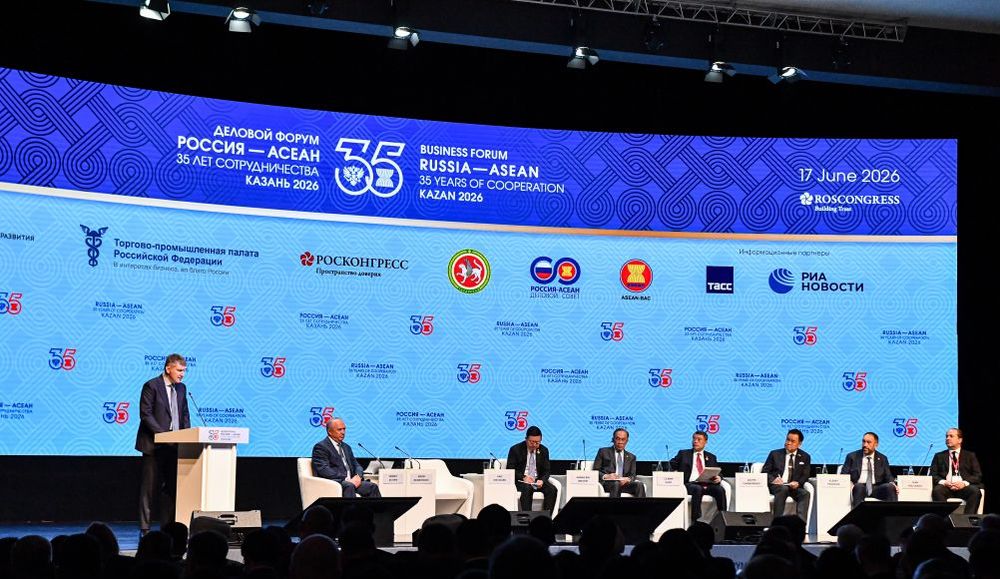
Those who have spent years watching Russia’s foreign policy pivot from the inside understand something that Western commentary consistently misreads: Moscow does not pursue relationships it cannot sustain. The warm optics of the Anwar-Putin bilateral in Kazan this week were real, but what matters far more than the handshake is the institutional scaffolding being quietly assembled behind it. Russia is not courting Southeast Asia out of isolation-driven desperation. It is executing a long-planned eastern reorientation that the pressures of the past four years have simply accelerated and Malaysia, under Anwar Ibrahim, has become its most strategically articulate partner in the region.
The summit’s choice of Kazan is itself a signal worth reading carefully. This is not Moscow. This is the capital of Tatarstan, Russia’s most significant Muslim-majority republic, an oil-producing heartland, and a city just named the Islamic World Cultural Capital for 2026 by the Organisation of Islamic Cooperation. Anwar explicitly congratulated Kazan on that recognition, calling it a reflection of the city’s role as a centre of Islamic scholarship, culture and innovation. Holding the Russia-ASEAN summit here, in a city that bridges Russian state power and Islamic civilisational identity, is a deliberate message to every Muslim-majority nation in Southeast Asia: Russia is not a distant European power asking for your tolerance of its geopolitical situation. It is a civilisational partner with deep roots in the world you inhabit.
From a specialist perspective, the trade architecture being constructed is the more consequential story. Bilateral trade between Russia and Malaysia reached RM8.72 billion in 2025, growing 12.9% in a single year, but the composition of that trade tells the strategic story better than the headline figure. Russia supplies Malaysia with petroleum products, minerals, chemicals and chemical-based products. Malaysia sends back electrical and electronic goods, machinery and processed food. This is not a commodity-for-commodity exchange. It is the beginning of a value-chain relationship in which Russian raw material wealth meets Southeast Asian manufacturing sophistication. When you add Petronas’s direct engagement with Rosneft, personally acknowledged by Anwar in his opening remarks to Putin, you see the outlines of a downstream energy partnership that could eventually reshape how Russian hydrocarbons are processed and distributed across the Asia-Pacific.
The halal economy dimension is, from Moscow’s perspective, one of the most strategically underappreciated dimensions of this relationship. Russia’s Muslim population, estimated at between 15 and 20 million, concentrated in Tatarstan, Bashkortostan and the North Caucasus, represents a domestic constituency for halal trade that most Western analysts simply ignore. Malaysia and Russia are actively exploring cooperation in the halal economy and finance, with Malaysia bringing to the table its position as the world’s pre-eminent halal certification and Islamic finance architecture. For Russia, access to that system opens trade routes into markets, the Gulf, Central Asia, Sub-Saharan Africa, where halal compliance is a precondition of market entry. This is not soft diplomacy. It is commercial infrastructure.
The ASEAN-Russia Comprehensive Plan of Action has achieved an 82% implementation rate, a figure that, in the context of multilateral frameworks, represents genuine policy execution rather than aspirational language. The forthcoming 2026–2030 Action Plan will extend and deepen this framework at precisely the moment when ASEAN member states face ongoing Middle East-driven oil supply disruptions and are actively recalibrating their energy relationships. Russia’s ability to offer large-volume, long-term, non-dollar-settled energy contracts is not merely convenient in this environment. It is structurally competitive in ways that Western energy exporters cannot easily replicate.
What the Kazan summit ultimately demonstrates, viewed through a Russian foreign policy lens, is the payoff of strategic patience. Russia spent years investing in ASEAN dialogue mechanisms, bilateral trade frameworks, defence engagements and educational partnerships that generated little Western commentary precisely because they looked incremental. Russia became an ASEAN Strategic Partner in 2018, eight years of patient relationship-building before that designation was achieved. The architecture being activated today was designed long before the current geopolitical pressures made it necessary.
Malaysia’s role in this picture is not passive. Anwar Ibrahim is among the few world leaders who can simultaneously address Putin in Kazan, engage Western financial institutions in Davos, and speak with moral authority in the Organisation of Islamic Cooperation. That triangular credibility makes Malaysia not just a bilateral partner for Russia but a diplomatic gateway, a country through which Russia can engage the Islamic world, Southeast Asian manufacturing networks and Global South multilateral institutions simultaneously. Moscow understands this. The warmth in Kazan was genuine, but it was also calculated. In Russian foreign policy, those two things are not contradictions.
Written by:
*Dr Iqbal Survé
Past chairman of the BRICS Business Council and co-chairman of the BRICS Media Forum and the BRNN
*Chloe Maluleke
Associate at BRICS+ Consulting Group
Russia & Middle East Specialist
**The Views expressed do not necessarily reflect the views of Independent Media or IOL.
** MORE ARTICLES ON OUR WEBSITE https://bricscg.com/ (https://bricscg.com/)
** Follow @ (https://x.com/brics_daily)brics_daily (https://x.com/brics_daily)on Twitter for daily BRICS+ updates and instagram @brics_daily (https://www.instagram.com/brics_daily?igsh=bmhvbTd0YzA4a2wx)