
Five days from now, South Africa faces a moment of reckoning, not because the government has declared a crisis, but precisely because it insists it hasn’t. The planned demonstrations of 30 June, anchored in the anti-immigration movement March and March’s ultimatum for undocumented foreigners to leave the country, have triggered the most visible display of security mobilisation this republic has seen since the catastrophic July 2021 unrest. The question on everyone’s lips is not whether the state is prepared, but whether preparation alone is sufficient.
The anatomy of a movement
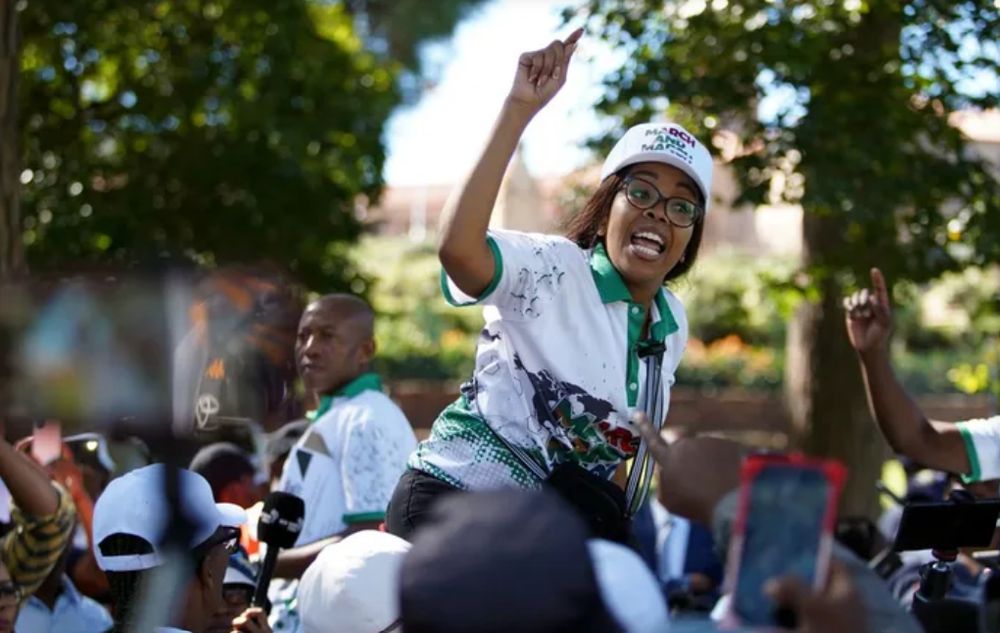
Understanding what South Africa is preparing for requires understanding March and March itself. The movement was founded in 2025 by Jacinta Ngobese-Zuma and has set a 30 June 2026 deadline for undocumented immigrants to leave South Africa, driving nationwide protests that have prompted a government-wide response. The movement frames its campaign as anti-illegal immigration, not xenophobia, but the distinction has proved difficult to maintain on the ground. While organisers have publicly denounced violence, there have been numerous instances of immigrants being assaulted and intimidated, and immigrant-owned shops looted.
The 30 June date itself was initially supercharged by misinformation. An AI-generated poster bearing the South African coat of arms and Home Affairs branding circulated on social media in May, falsely suggesting the government had endorsed the deadline. The government publicly dismissed the poster as fake and clarified there was no such official deadline — yet the date has continued to gain traction among activists. This is precisely how dangerous social tinderboxes ignite: a fabrication acquires the emotional weight of fact, and by the time it is corrected, the momentum is already unstoppable.
R600 million and the spectre of July 2021
The scale of security investment is staggering. R600 million has been diverted from existing government budgets to fund a special security operation, with primary focus on hotspots identified in KwaZulu-Natal, Gauteng, and the Western Cape. That is not a policing budget line, that is a national emergency price tag. Cachalia has been frank about what this costs the country: money redirected from community safety upgrades, police station improvements, and basic service delivery.
The July 2021 unrest, sparked by the imprisonment of former president Jacob Zuma. left more than 350 people deceased, shopping centres gutted, warehouses looted, and supply chains shattered. The South African Human Rights Commission later estimated the economic damage at approximately R50 billion, with roughly two million jobs lost or disrupted. The comparison is instructive. KwaZulu-Natal and Gauteng were then the epicentres of collapse. Private security intelligence firm Fidelity Business Intelligence has assessed the same two provinces as the primary hotspots for anti-illegal immigration unrest heading into 30 June. The geography of instability has not shifted.
What has shifted, at least on paper,is institutional awareness. Unlike the lead-up to the July 2021 unrest, the planned 30 June demonstrations have been the subject of extensive public discussion, visible security planning, and acknowledgement from NATJOINTS, SAPS, and other security stakeholders. Whether these measures prove sufficient remains to be seen, but they suggest a level of situational awareness that was absent five years ago.
A force multiplier: Private security joins the line
One of the more strategically significant elements of this operation is the formalisation of the public-private security partnership. Dimpane described the private security industry as a "critical force multiplier" for law enforcement, noting that hundreds of thousands of officers are deployed across communities, business districts, shopping centres, and residential areas nationwide. Security companies have confirmed they are pooling resources and sharing intelligence to support SAPS operations, with personnel and assets positioned both on the ground and in the air. This mirrors approaches seen in high-tension democracies globally — from France’s coordination between Police Nationale and private contractors during the 2023 urban unrest, to Kenya’s integrated response frameworks during post-election violence. Hybrid security architectures, when well-coordinated, are more resilient than state-only deployments.
The deeper question
Security analyst Gareth Newham has observed that if South Africa had properly learned the lessons of July 2021, SAPS would not now need to spend R600 million on a special operation, noting that preparedness is cheaper than panic. and that intelligence-led policing is cheaper than emergency mobilisation. It is a pointed critique, and an accurate one.
The state’s assurances are credible on logistics. What remains unresolved is the structural reality underneath: migrants represent fewer than four million of South Africa’s 63 million people, yet xenophobic violence remains a persistent flashpoint. When economic anxiety has no institutional outlet, it finds a human one. Policing a symptom for one day does not cure the condition.
South Africa on 30 June will be watched closely, not only by its own citizens, but by the region and the world. Countries including Malawi, Ghana, Mozambique, Nigeria, and Zimbabwe have already helped more than 3,000 of their citizens return home in anticipation of what may unfold. The security architecture is in place. Whether social architecture can hold is a separate, and far harder, question.
News (https://iol.co.za/news/)BRICS (https://iol.co.za/iol/news/brics/)
BRICS+ Series: Zimbabwe’s two-track economy of power and poverty
Dr Iqbal Survé (https://iol.co.za/authors/dr-iqbal-surve/)andSesona Mdlokovana (https://iol.co.za/authors/sesona-mdlokovana/)|Published 6 days agoAsk AI4min
Zimbabwe’s President Emmerson Mnangagwa secured 2 350 711 votes.
Image: internal
The amendment that ends the ballot
On 18 June 2026, Zimbabwe’s National Assembly passed the Constitution of Zimbabwe Amendment (No. 3) Bill, with 216 lawmakers voting in favour, comfortably clearing the 187-vote threshold needed for a two-thirds majority. The bill’s headline effect is structural: it would postpone elections due in 2028 to 2030 and extend President Emmerson Mnangagwa’s term from five to seven years, while also shifting presidential elections from a direct popular vote to selection by Parliament.
This is not a minor procedural tweak. The amendment would also enlarge the Senate with ten presidential appointees, establish a new Electoral Delimitation Commission, transfer voters’ roll functions to the Registrar-General, and repeal the Gender Commission and the National Peace and Reconciliation Commission, institutions originally designed as checks on executive power. Critics argue the package would erode the democratic gains of the 2013 Constitution and weaken checks and balances, while the government insists the changes are "constructive reforms" meant to strengthen democratic structures and promote long-term stability.
The process leading here has been anything but clean. Public hearings, a constitutionally mandated step, were marred by chaos: human rights lawyer Doug Coltart was assaulted and had his phone taken and glasses broken at a Harare hearing, while critics elsewhere were drowned out by boos, heckling and intimidation. Opposition figure Tendai Biti was detained on bail after allegedly holding an unsanctioned meeting opposing the amendments. Legal resistance has so far failed: court challenges from activists and liberation-war veterans were struck off the roll this week on technical grounds.
A familiar continental playbook
Mnangagwa’s manoeuvre fits a well-worn pattern across the region, incumbents who, rather than amending term limits outright, recalibrate the electoral calendar or selection method to the same effect. What distinguishes Zimbabwe’s case is the irony of its provenance: Mnangagwa himself came to power via the 2017 military coup that ousted Robert Mugabe, a leader whose own 37-year rule became shorthand for African gerontocracy. Should the amendment pass the Senate and survive constitutional review, Mnangagwa, now 83, would join a club of the world’s oldest and longest-serving African leaders.a roster that already includes Cameroon’s Paul Biya and Equatorial Guinea’s Teodoro Obiang. The bill still requires Senate approval, but ZANU-PF controls the upper chamber largely through traditional leaders and other proxies who reliably vote with the party, making passage all but assured.
$5 More, Same Old Story
Against this backdrop, Cabinet’s wage announcement reads almost like political theatre. On 16 June, ministers approved raising the minimum wage for domestic workers from $85 to $90, with workers in unclassified operations rising to $270, both payable in local currency, drawing on recommendations from the tripartite Wages and Salaries Advisory Council, presented by Labour Minister Edgar Moyo. Within the category, cooks and housekeepers will earn $99, child and disability minders $108 (up from $95), and Red Cross-certified carers $117 (up from $100).
The comparison that matters most is the one government would rather avoid: domestic workers remain excluded from the dramatically higher benchmark set for the rest of the workforce. They were left out of Zimbabwe’s $150 monthly minimum wage introduced in December 2024, meaning the country’s most undervalued labour sector, predominantly women, sits at barely 60% of the floor guaranteed elsewhere. As labour analyst Ricardo Vale notes, the legal minimum wage for domestic work is typically revised only once a year, while a ZDAWU representative points out that domestic workers remain Zimbabwe’s most lowly paid and largely unregulated, since they fall outside any National Employment Council.
There is a genuine silver lining buried in the macro data: Zimbabwe’s currency, the ZiG, has stabilised, with year-on-year inflation falling to 3.8% in February 2026 under tight monetary policy, strong gold prices and reserve accumulation, a remarkable turnaround for a country that recorded 175% inflation in 2023 and hyperinflation exceeding 700% historically. But low headline inflation cannot erase years of cumulative currency collapse, and a $5 nominal increase changes little when measured against that scar tissue.
The bigger picture
Both stories share a common thread: institutional power consolidating at the top while the bargaining power of ordinary Zimbabweans, voters and domestic workers alike, remains structurally constrained. One reform extends a presidency by two years through Parliament rather than the ballot box; the other extends a paycheque by $5 through Cabinet decree rather than collective bargaining. Neither was won by the people most affected.
Written by:
*Dr Iqbal Survé
Past chairman of the BRICS Business Council and co-chairman of the BRICS Media Forum and the BRNN
*Sesona Mdlokovana
Associate at BRICS+ Consulting Group
Africa Specialist
**The Views expressed do not necessarily reflect the views of Independent Media or IOL.
** MORE ARTICLES ON OUR WEBSITE https://bricscg.com/ (https://bricscg.com/)
** Follow @ (https://x.com/brics_daily)brics_daily (https://x.com/brics_daily)on Twitter for daily BRICS+ updates and instagram @brics_daily (https://www.instagram.com/brics_daily?igsh=bmhvbTd0YzA4a2wx)