
BYD’s latest performance highlights the rapid evolution of China’s leading electric vehicle manufacturers into broader technology companies. While the company has recorded its first monthly sales growth in nine months, it is simultaneously positioning itself at the forefront of emerging industries such as artificial intelligence, autonomous driving and humanoid robotics. The convergence of these technologies is reshaping global competition and could redefine BYD’s role in the future economy.
Driving Growth Through Innovation
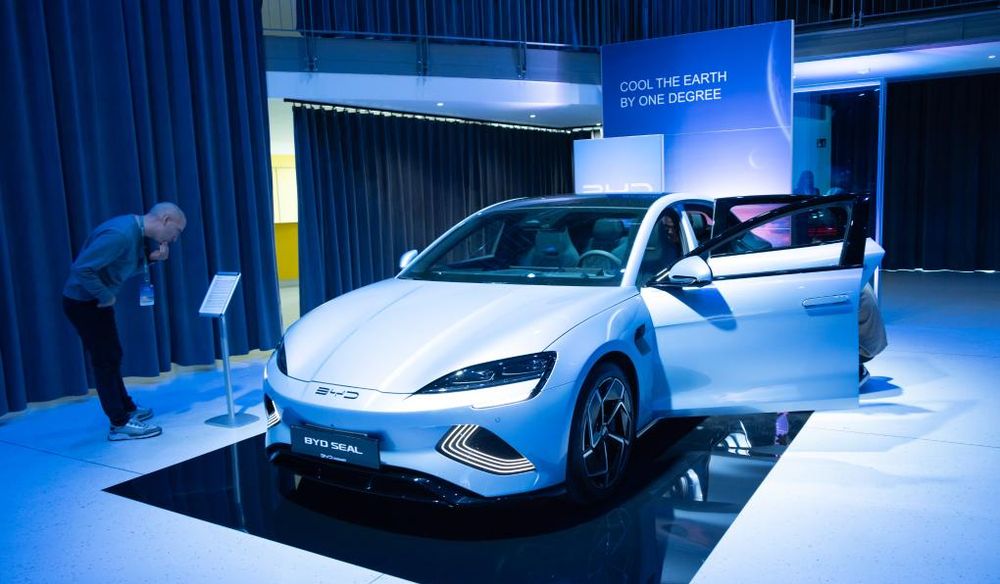
BYD, the world’s largest producer of new energy vehicles (NEVs), appears to be entering a new phase of its development. The Shenzhen-based company reported sales of 383,453 NEVs in May 2026, a modest but significant 0.3% increase from the same month a year earlier. While the growth rate was small, it marked the company’s first year-on-year monthly sales increase in nine months, suggesting that demand may be stabilising after a challenging period for China’s highly competitive EV sector.
The figures also highlighted the growing importance of overseas markets. BYD exported 160,644 vehicles during May, underlining the company’s success in expanding beyond China and positioning itself as a truly global automotive brand.
Passenger vehicle sales remained broadly flat at 376,990 units. However, a closer look reveals shifting consumer preferences. Battery electric vehicle (BEV) sales declined by 2.8%, while plug-in hybrid electric vehicle (PHEV) sales rose by 3.3%, indicating continued demand for hybrid technologies in markets where charging infrastructure remains limited.
Commercial vehicles also delivered strong performance, with sales increasing to 6,463 units compared with 5,546 a year earlier. Despite overall monthly growth, BYD’s year-to-date sales for the first five months of 2026 remained down 20.3% compared with the same period in 2025, demonstrating that competition and market pressures continue to pose challenges.
Building the Foundations of an AI Ecosystem
BYD’s ambitions increasingly extend beyond manufacturing vehicles. In recent weeks, the company launched the Dolphin Cargo e-Van in the United Kingdom and unveiled the Xuanji A3, which it described as China’s first 4-nanometre intelligent driving chip.
The significance of the Xuanji A3 extends far beyond autonomous driving. Advanced chips, artificial intelligence models, sensors, batteries and electric actuators form the technological backbone of both intelligent vehicles and advanced robotics. By developing these technologies internally, BYD is steadily building an integrated AI ecosystem that can support multiple industries.
The company’s investment in semiconductor design, battery production and intelligent driving systems reflects a broader strategy to control critical technologies rather than relying on external suppliers. This vertical integration has been one of BYD’s greatest competitive strengths in the automotive sector and could prove equally valuable in robotics.
The Leap Into Humanoid Robotics
In its clearest statement to date regarding future diversification plans, BYD has officially confirmed that it is actively developing humanoid robots.
Executive Vice President Li Ke revealed that the company is already deeply involved in research and development efforts. According to Li, future success in robotics will depend largely on manufacturing scale, software capabilities and hardware integration—areas where BYD already possesses substantial advantages.
The company believes that modern intelligent vehicles and humanoid robots share many of the same technological foundations. Both require sophisticated sensors, artificial intelligence, advanced computing platforms, electric motors and highly efficient battery systems. As a result, technologies developed for autonomous and assisted driving can potentially be adapted for robotic applications.
Perhaps most notably, BYD plans to utilise its extensive dealer network to distribute humanoid robots if the products eventually reach mass-market readiness. Such an approach would provide the company with a significant commercial advantage by leveraging an existing global sales and service infrastructure.
BYD is also considering an open-platform model. While it intends to develop its own signature robots, the company has indicated a willingness to collaborate with external robotics firms, mirroring its successful approach in the automotive sector where it combines in-house manufacturing with extensive supplier partnerships.
China’s New Robotics Race
BYD’s entry into humanoid robotics reflects a broader trend across China’s technology and automotive industries. As artificial intelligence advances and autonomous systems become more sophisticated, the boundaries between vehicles, robots and intelligent machines are increasingly blurring.
Several Chinese automakers have already begun positioning themselves in the sector. Chery recently launched commercial sales of its Mornine M1 humanoid robot, while Xpeng has linked its future robotics ambitions directly to its AI and autonomous driving strategies.
What distinguishes BYD is its scale. Few companies can match its manufacturing capacity, supply-chain management expertise, battery production capabilities and growing semiconductor portfolio. Having already transformed itself from a battery manufacturer into a global automotive powerhouse, the company now appears intent on becoming a major participant in the next wave of intelligent machines.
For Africa and other emerging markets, these developments carry important implications. As Chinese companies accelerate innovation in electric mobility, artificial intelligence and robotics, the technologies shaping future transport systems, logistics networks, healthcare services and industrial production may increasingly originate from the same firms.
BYD’s latest sales recovery may therefore represent more than a temporary improvement in vehicle demand. It may also signal the beginning of a broader transformation, one in which the company evolves from an electric vehicle manufacturer into a diversified technology leader operating at the intersection of mobility, AI and robotics.
Written By
*Cole Jackson
*Director of International Relations
Sekunjalo Group Africa Holdings
**The Views expressed do not necessarily reflect the views of Independent Media or IOL.
** MORE ARTICLES ON OUR WEBSITE https://bricscg.com/ (https://bricscg.com/)
** Follow @ (https://x.com/brics_daily)brics_daily (https://x.com/brics_daily)on Twitter for daily BRICS+ updates and instagram @brics_daily (https://www.instagram.com/brics_daily?igsh=bmhvbTd0YzA4a2wx)