
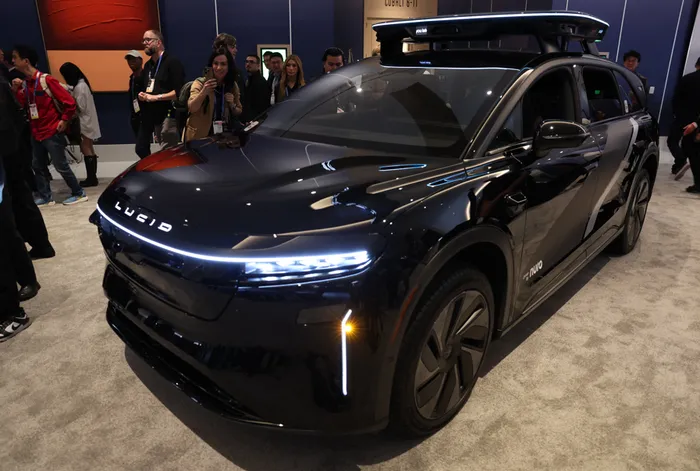
Lucid Group’s transition from vehicle assembly to full-scale manufacturing in Saudi Arabia marks more than a production milestone for an electric vehicle (EV) startup. It reflects a deeper shift in how the Kingdom is using sovereign capital to reposition itself within global industrial value chains.
Since acquiring a majority stake in Lucid in 2019, the Public Investment Fund (PIF) has steadily increased its financial and strategic commitment to the company. With total investment now reaching approximately $8 billion, Lucid has effectively become a cornerstone asset within Saudi Arabia’s long-term industrial vision. The decision to scale manufacturing locally rather than limit operations to assembly underscores a deliberate effort to move beyond consumption and import dependence toward production, technology absorption, and skills development.
From Assembly to Industrial Anchoring
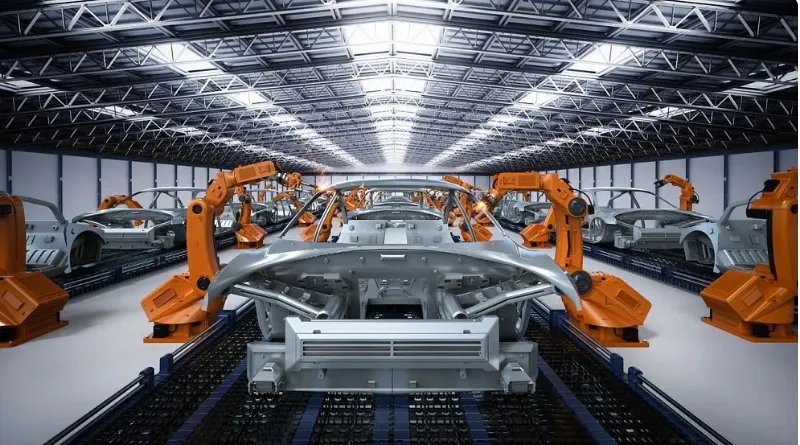
Lucid’s facility near Jeddah initially functioned as an assembly hub, receiving semi-knocked-down vehicles for final completion. The shift to full manufacturing represents a qualitative change. It introduces upstream activities such as tooling, advanced manufacturing processes, and supplier integration, all of which are critical to embedding an industrial ecosystem rather than a standalone plant.
Saudi Arabia’s ambition is not merely to host foreign firms, but to anchor them. By committing to local manufacturing, Lucid becomes part of a broader experiment in whether sovereign-backed industrialisation can accelerate what traditionally takes decades: the creation of domestic manufacturing capacity in high-tech sectors. The target of 150,000 vehicles annually by 2029 is ambitious, but its symbolic value may outweigh early production volumes. It signals seriousness to suppliers, logistics firms, and downstream service providers considering whether to follow.
This mirrors a wider Gulf pattern. Across the region, governments rather than private venture capital are underwriting industrial risk in strategic sectors. EVs, like artificial intelligence and renewables, are viewed not just as commercial opportunities but as future-defining industries tied to energy transition, employment, and geopolitical relevance.
Sovereign Capital as Industrial Policy
Lucid’s Saudi expansion also illustrates how the PIF is redefining the role of sovereign wealth. Rather than acting solely as a financial investor seeking returns, the fund is increasingly functioning as an industrial policy instrument. Capital injections into Lucid have coincided with strategic milestones: localisation, regional market expansion, and production commitments aligned with Vision 2030.
This approach carries both advantages and risks. On the one hand, sovereign backing allows Lucid to pursue long-term capacity building without the immediate profitability pressures faced by purely private firms. On the other, it ties the company’s trajectory closely to Saudi Arabia’s domestic priorities. Lucid’s future, in this sense, is as much political as it is commercial.
For Saudi Arabia, the calculus is clear. EV manufacturing aligns with decarbonisation goals, diversification away from hydrocarbons, and the desire to build globally competitive industrial champions. It also offers a pathway to reposition the Kingdom within the global automotive supply chain at a moment when legacy manufacturers are themselves undergoing disruption.
Market Reality and Strategic Patience
Lucid’s market performance, however, highlights the tension between long-term industrial strategy and short-term market sentiment. Despite sovereign backing and geographic expansion, the company’s share price has declined sharply over the past year. This disconnect underscores a key feature of state-led industrial bets: they are not designed to satisfy quarterly market expectations.
Saudi Arabia appears willing to absorb this volatility. The Kingdom’s strategy prioritises strategic optionality over immediate financial returns. By investing through cycles, it is effectively betting that early participation in EV manufacturing will yield dividends in technology transfer, workforce development, and regional market leadership, even if the initial commercial path is uneven.
Implications Beyond Saudi Arabia
Lucid’s Saudi manufacturing push has broader implications for emerging markets and industrialising economies. It challenges the assumption that advanced manufacturing must be organically private-led to succeed. Instead, it raises a more uncomfortable question for traditional industrial powers: can sovereign-backed models move faster in reshaping industrial geography than market-driven ones?
As EV demand grows across the Middle East and Africa, Saudi Arabia is positioning itself not just as a consumer market, but as a production and export hub. Whether Lucid ultimately becomes a global EV leader or a strategically subsidised niche player, its Saudi expansion has already altered perceptions of where advanced manufacturing can take root.
In that sense, Lucid is less important as a carmaker than as a case study. It offers a glimpse into how capital-rich states are attempting to manufacture their way into the future, one factory, one strategic investment, and one calculated risk at a time.
Chloe Maluleke
Associate at BRICS+ Consulting Group
Russian & Middle Eastern Specialist