

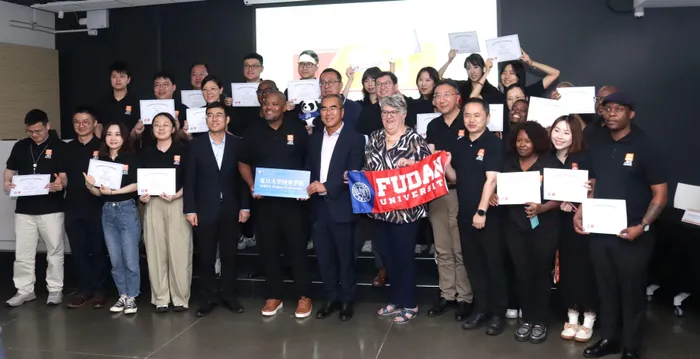
The University of Johannesburg this week hosted a three-day Comparative Governance Forum in partnership with Fudan University, bringing together South African and Chinese academics, policymakers and researchers to engage on governance, innovation and development in a rapidly changing global context.
Fudan University is one of China’s leading higher education institutions, internationally recognised for its work in governance, public policy and international relations.
The forum was convened by the Centre for Public Policy and African Studies at the Johannesburg Business School and was officially opened by Professor Alistair Mokoena, Executive Dean of the Johannesburg Business School, alongside Professor Su Changhe, Dean of the School of International Relations and Public Affairs at Fudan University.
As part of the programme, Mokoena delivered a lecture titled Digital Transformation Frontiers and Economic Growth in Africa, highlighting how digital technologies such as artificial intelligence and data science could improve public service delivery, strengthen revenue collection, enhance transparency in public procurement and support inclusive economic growth across the continent.
Mokoena emphasised the need to expand internet access, provide affordable smartphones and equip young people with digital skills, while addressing structural barriers such as language and affordability, adding that peace, economic opportunity and the meeting of basic needs were essential for innovation and meaningful participation in Africa’s digital economy.
China–South Africa relations in a “new era”
The forum concluded on Thursday with an address by Pan Qingjiang, a veteran Chinese diplomat and Consul General of the People’s Republic of China in Johannesburg, who underscored the importance of sustained dialogue between academic institutions, think tanks and policymakers in an increasingly volatile global environment.
Pan said China–South Africa and China–Africa relations had entered a “new era” characterised by deeper political trust, expanding economic cooperation and growing people-to-people exchanges. He added that, as members of the Global South, China and South Africa should strengthen coordination in international and regional affairs to advance global governance reform and shared modernisation goals.
Inequality, trade and the unemployment crisis
Following the Consul General’s address, economist Michael Sachs from the Nucleus Institute presented an overview of South Africa’s economic structure, describing the country as “a world in one country” marked by extreme inequality, mass unemployment and deep integration into global trade and financial systems.
Sachs said South Africa remained heavily dependent on commodity exports dominated by mining, energy and other resource-based industries, while manufacturing had declined over time in what he described as premature deindustrialisation.
He highlighted shifting global trade patterns, noting the growing importance of Asia — particularly China — in South Africa’s trade profile, while warning that unemployment, rather than fiscal pressures, posed the most serious long-term threat to economic sustainability.
Sustaining the dialogue
Busani Ngcaweni, Director of the Centre for Public Policy and African Studies at the Johannesburg Business School, thanked delegates and participants for their engagement and noted that the three-day forum deepened discussion and knowledge exchange.
The University of Johannesburg said the engagement reaffirmed the Johannesburg Business School’s commitment to international collaboration, Africa-focused scholarship and thought leadership in public policy and governance.
The forum took place against the backdrop of deepening political and economic ties between South Africa and China, with China remaining South Africa’s largest trading partner (https://iol.co.za/the-star/opinion/2024-06-05-china-is-africas-largest-trading-partner-for-15-years-and-ties-continue-to-strengthen/) and a key player in Africa’s development landscape.
Discussions reflected growing recognition of the need for more balanced trade relations, expanded cooperation beyond commodities, and closer alignment between governance, industrial policy and development strategies as both countries navigate shifting global power dynamics and debates around reforming global governance institutions.
jonisayi.maromo@iol.co.za
IOL News
Get your news on the go. Download the latest IOL App for Android (https://play.google.com/store/apps/details?id=com.iol.news.prod&hl=en_ZA&pli=1) and IOS (https://apps.apple.com/za/app/iol-news/id479535200) now.