
Uzbekistan does not make the front pages very often. It is landlocked, post-Soviet, rapidly urbanising, and home to 38 million people who are largely invisible in Western media unless the subject is gas pipelines or the occasional human rights report. But something worth paying attention to happened in Tashkent last week. President Shavkat Mirziyoyev signed the law formally joining Uzbekistan to the New Development Bank, the multilateral lender founded by the BRICS nations in 2015 as an alternative to the Washington-led financial order.
The NDB has now approved 139 projects worth nearly $42 billion since its founding. It is growing, deliberately and methodically, bringing in new members from across the Global South. Colombia joined. Algeria joined. Ethiopia and Indonesia are in talks. Each membership adds capital, credibility, and reach. And each one is a small but legible signal: the architecture of development finance is no longer a Western monopoly.
For Uzbekistan, the calculation is straightforward. The country is in the middle of one of the most ambitious infrastructure builds in its history consisting of 782 industrial and infrastructure projects planned for 2026 alone, worth $52 billion in total value. Its economy grew at 7.7% in 2025 and is projected to hold around 6.7% in 2026. It needs capital, and it needs it at scale. The Asian Development Bank is present. The World Bank is present. The EBRD has invested nearly $7 billion to date, making Uzbekistan its largest recipient in the region for six consecutive years. Now the NDB will be present too. The point is not to replace any of these institutions. The point is that Uzbekistan is building the kind of diversified financing portfolio that gives a country genuine room to negotiate.
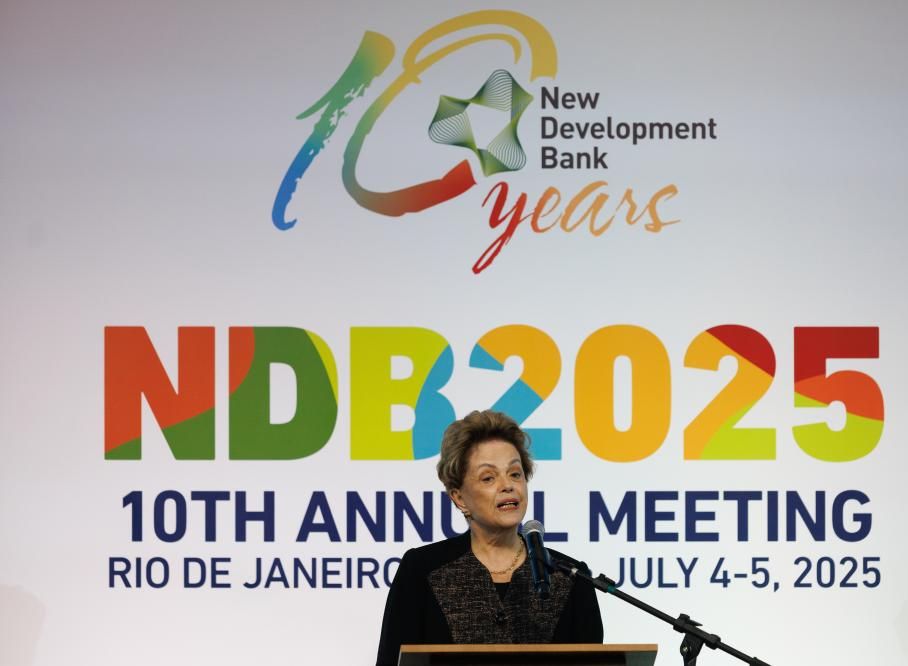
In June 2025, NDB President Dilma Rousseff visited Tashkent and a programme of priority projects worth $5 billion was agreed, covering irrigation modernisation, mining development, and infrastructure. Those are not abstract commitments. Uzbekistan’s irrigation systems are ageing infrastructure inherited from the Soviet era, critical for a country where agriculture employs a significant portion of the population and water scarcity is a growing concern. The Aral Sea disaster, one of the worst environmental catastrophes of the twentieth century, happened in this region. Investment in water management here is not development jargon. It is existential.
What the NDB offers that the World Bank and the EBRD sometimes do not is speed and fewer conditions. This is a recurring theme in the Global South’s engagement with BRICS financial institutions. It is not that countries do not want accountability or transparency, most serious policymakers understand the value of institutional standards. It is that the traditional conditionality frameworks attached to Western development finance have a history of arriving with political strings that borrowing governments find difficult to manage domestically. The NDB, at least in principle, operates differently. That is part of its appeal.
Uzbekistan’s foreign policy under Mirziyoyev has been defined by strategic openness since he came to power in 2016. The country has normalised relations with all five Central Asian neighbours, deepened ties with China through the Belt and Road framework, maintained strong relations with Russia, and simultaneously courted European and American investment. It is neither pro-Western nor anti-Western. It is pro-Uzbekistan. In a world that keeps demanding countries pick a side, that is an increasingly sophisticated position to hold.
The NDB membership fits neatly into this posture. It does not represent a turn away from Western institutions. Uzbekistan is simultaneously in the final stages of WTO accession negotiations, a process that requires significant alignment with Western trade norms. What it represents is the construction of an institutional network broad enough that no single partner holds decisive leverage.
This is, increasingly, what development strategy looks like for the countries of the Global South that are paying attention. Not alignment, but optionality. The countries that navigate the next twenty years most successfully will likely be the ones that managed to attract Chinese infrastructure investment, maintain IMF credit access, deepen regional trade, join BRICS-adjacent institutions, and still sit across the table from European partners without any of those relationships cancelling out the others.
Uzbekistan is doing exactly this and doing it while posting some of the strongest economic growth numbers in the region. The NDB is not going to reshape the global financial system overnight, but it is growing. Its membership is expanding. Its project portfolio is real. And every country that joins it sends the same quiet message: we are building a world with more doors than the one we inherited.
Written by:
*Dr Iqbal Survé
Past chairman of the BRICS Business Council and co-chairman of the BRICS Media Forum and the BRNN
*Chloe Maluleke
Associate at BRICS+ Consulting Group
Russia & Middle East Specialist
**The Views expressed do not necessarily reflect the views of Independent Media or IOL.
** MORE ARTICLES ON OUR WEBSITE https://bricscg.com/ (https://bricscg.com/)
** Follow @ (https://x.com/brics_daily)brics_daily (https://x.com/brics_daily)on Twitter for daily BRICS+ updates and instagram @brics_daily (https://www.instagram.com/brics_daily?igsh=bmhvbTd0YzA4a2wx)