

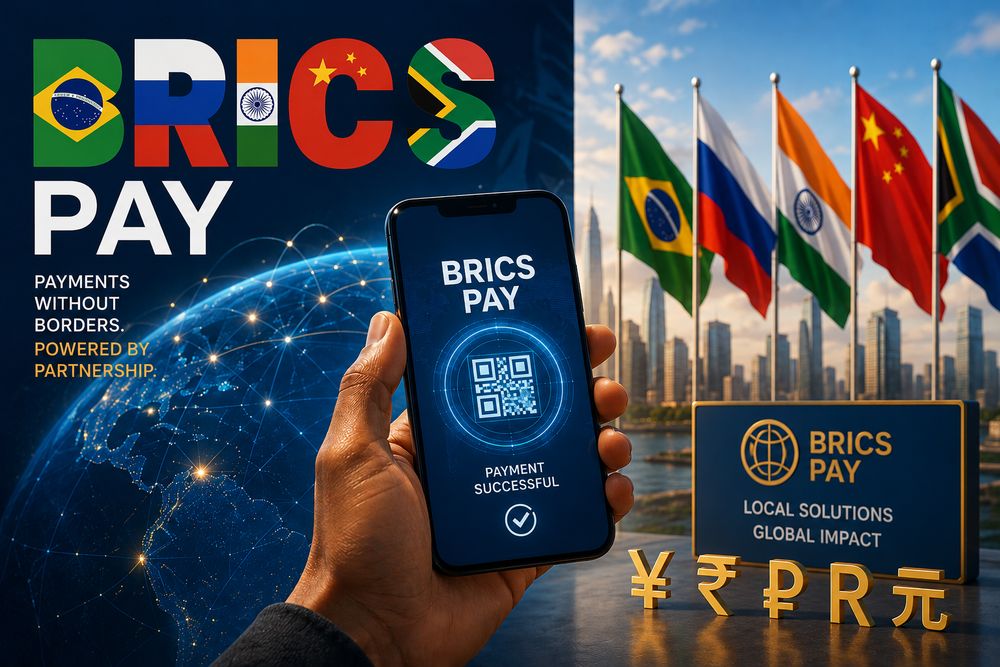
With just over two months to go before India hosts the 18th BRICS Summit in New Delhi, the bloc’s most closely watched financial initiative is entering its final testing phase. BRICS Pay, the decentralised cross-border payment architecture designed to link national settlement systems such as India’s UPI, China’s CIPS, and Russia’s SPFS, is now targeted for operational deployment when leaders gather in September. If it works as advertised, it would mark the most concrete step yet toward a long-discussed goal: giving BRICS+ economies a way to settle trade without routing transactions through Western-controlled payment rails.
From Talking Point to Test Case
For years, “de-dollarisation” was more rhetoric and idea than a roadmap. The 2025 Rio Declaration, issued at the close of Brazil’s presidency, notably stopped short of naming de-dollarisation as a formal bloc objective, focusing instead on the more modest language of “expanded local-currency trade.” That caution reflected real divisions within the group, Brazil and India have historically been warier than Russia or China of moves that could be read as openly confrontational toward the US dollar.
India’s 2026 chairship has taken a more technical, less rhetorical approach to the same underlying problem. Rather than campaigning for a single BRICS currency, an idea that has periodically drawn statements of concern from Washington but never gained real traction among the bloc’s own finance ministries. New Delhi has focused its energy on interoperability. The question isn’t “what replaces the dollar,” but “can a trader in São Paulo settle an invoice with a supplier in Shanghai without either side touching a correspondent bank in New York or London.”
What BRICS Pay Actually Does
Unlike a centralised payment network, BRICS Pay is designed as a linking layer between existing domestic systems rather than a replacement for them. India’s Reserve Bank has placed central bank digital currency (CBDC) interoperability squarely on the New Delhi summit agenda, and the mechanics under discussion would allow a payment initiated in one member state’s national system to be recognised and settled in another’s, with an underlying CBDC or existing digital-currency rail handling the cross-border leg. In principle, this sidesteps the correspondent-banking bottlenecks that have made cross-border settlement among emerging economies slower and costlier than it needs to be, particularly for smaller exporters who don’t have the scale to absorb multiple currency-conversion fees.
The appeal for BRICS+ economies is straightforward. Intra-bloc trade has been growing steadily, India and Russia alone reported bilateral trade hitting a record $68.7 billion in the most recent reporting period, and China-Russia trade has topped $200 billion annually for three consecutive years. As that volume grows, so does the cost, in both money and geopolitical exposure, of routing an ever-larger share of it through dollar-denominated intermediaries subject to US sanctions regimes and compliance requirements that member states have no say in shaping.
The Harder Problem: Trust, Not Technology
Financial engineers who have looked at similar interoperability projects elsewhere caution that the technology is rarely the limiting factor. The harder problems are institutional: whose central bank holds ultimate settlement authority in a dispute, how exchange rate risk is priced and absorbed when a payment crosses two or three national systems in a single transaction, and how anti-money-laundering standards get reconciled across jurisdictions with very different regulatory philosophies. China’s CIPS, India’s UPI, and Russia’s SPFS were each built for different purposes and under different legal frameworks; stitching them together without creating new points of failure or new avenues for regulatory arbitrage is a genuinely difficult engineering and diplomatic task, not just a technical one.
There is also the membership question. BRICS now counts eleven full members after the recent additions of Indonesia and, contingent on formal confirmation, Saudi Arabia, alongside a widening circle of partner states. Every additional member is another domestic payment system that eventually needs to be onboarded, another central bank with its own risk tolerance, and another set of capital-control rules that BRICS Pay would need to respect rather than override. Zimbabwe’s ongoing negotiations to join the New Development Bank and Uzbekistan’s parallel accession process are reminders that the bloc’s institutional plumbing is being built even as its membership keeps expanding, a moving target that complicates any single deployment timeline.
What to Watch in New Delhi
Three things will indicate whether September’s summit produces a genuine milestone or another declaration of intent. First, whether the summit communique includes concrete operational commitments, specific currency pairs, specific pilot corridors, specific volume targets, rather than general language about “exploring” interoperability. Second, whether the New Development Bank, freshly awarded a stable AAA credit rating by China Chengxin International, plays a visible role in underwriting early settlement risk, which would signal institutional backing beyond political statements. Third, whether any G7 government responds publicly, since a muted reaction would suggest BRICS Pay is being read in Western capitals as a narrow trade-facilitation tool rather than a serious challenge to dollar primacy.
For now, the honest assessment is that BRICS Pay represents real progress on a genuinely difficult problem, built on top of trade relationships that are already deepening on their own. Whether it becomes the operational backbone of a new payments era or another ambitious pilot that quietly narrows in scope will become clear only once transactions, not declarations, start flowing through it.
Written by:
*Dr Iqbal Survé
Past chairman of the BRICS Business Council and co-chairman of the BRICS Media Forum and the BRNN
*Chloe Maluleke
Associate at BRICS+ Consulting Group
Russia & Middle East Specialist
** Follow @ (https://x.com/brics_daily)brics_daily (https://x.com/brics_daily)on Twitter for daily BRICS+ updates and instagram @brics_daily (https://www.instagram.com/brics_daily?igsh=bmhvbTd0YzA4a2wx)