

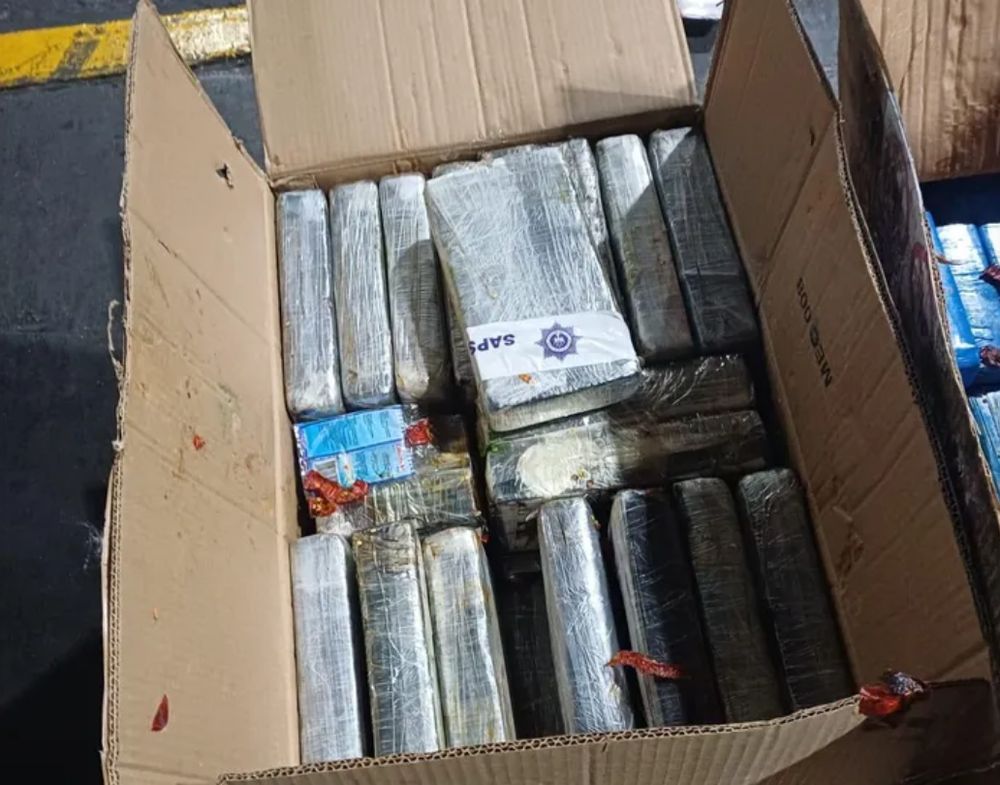
For decades, West Africa’s role in the global drug trade was that of a corridor: cocaine from Latin America passed through its ports on the way to Europe, and traffickers took a cut along the way. That story has changed. In May, Nigeria’s drug enforcement agency dismantled what it called the country’s largest-ever methamphetamine bust, over two tonnes of the drug, worth an estimated $360 million, produced in a forest laboratory staffed by Mexican "cooks" working alongside Nigerian operatives. A month later, a second laboratory was uncovered in neighbouring Oyo State. Since 2023, according to US Africa Command, fourteen Mexican-run meth labs have been raided across the continent, four of the five found this year alone were in Nigeria.
This is not an isolated law-enforcement anecdote. It is evidence of a structural shift: West Africa is no longer simply a route drugs pass through, but a place where they are made.
Why This Region, Why Now?
The logic is coldly rational from a cartel’s perspective. Unlike cocaine, which depends on coca leaf grown almost exclusively in South America, methamphetamine can be synthesised anywhere with the right precursor chemicals. West Africa offers everything an illicit manufacturer wants: dense, unpoliced forest for concealment; a young, fast-growing population that supplies both cheap labour and an expanding consumer market; porous borders; and weak regulation of the industrial chemicals needed for production. Add to this direct shipping access to Europe and Asia, and the region becomes not a compromise location but a genuinely attractive one.
There is also a geopolitical trigger. Since 2025, intensified US pressure on Mexico’s Sinaloa and Jalisco New Generation cartels has squeezed their traditional smuggling corridors into North America. Officials at Africom describe this as one factor, not the whole explanation, since these cartels have operated in Africa since the 1990s, pushing organisations to diversify and deepen their footholds elsewhere. When one door narrows, global criminal networks do not shrink; they expand sideways.
The Human Cost Is Not Abstract
It is tempting to view this as a story about seizures, tonnage and dollar values. It is not. Nigeria’s own 2018 national survey found that 14.4% of its adult population had used an illicit drug , more than double the global average estimated by the UN Office on Drugs and Crime. The UNODC’s 2024 and 2025 World Drug Reports confirm that local consumption across Africa is diversifying rapidly, moving beyond cannabis into methamphetamine, cocaine and pharmaceutical opioids, with treatment services badly under-resourced in West Africa specifically. Meanwhile Europe has recorded a 47% rise in methamphetamine use over the past decade, and East and South-East Asia logged record seizures in 2024. Every gram produced in a Nigerian forest has a destination and increasingly, that destination includes the community around the laboratory itself.
What This Demands
Nigeria’s response, physically relocating a federal court into the jungle to try suspects at the scene of the alleged crime , signals genuine institutional resolve. It should be recognised as such. But no single country, however committed, can out-enforce a transnational cartel structure that has been embedding itself in Africa for thirty years. The comparison that should worry policymakers is Mexico itself: cartels did not become intractable overnight, but through years of being treated as a domestic crime issue rather than a strategic security threat requiring sustained regional and international cooperation, chemical-supply-chain controls, and long-term investment in enforcement capacity and treatment infrastructure alike.
The alternative, allowing production to become entrenched under the assumption that seizures alone constitute containment risks repeating a pattern the world has already watched play out in Latin America and Southeast Asia. Once cartel infrastructure roots itself in a region, dislodging it becomes a multi-decade undertaking measured in lives, not just law-enforcement statistics.
A Narrow Window
West Africa currently sits at an inflection point comparable to where Mexico stood before its cartels became permanent fixtures of the state’s security calculus. The evidence , fourteen labs since 2023, rising seizures, a documented spike in regional consumption, indicates the window to prevent that outcome is still open, but narrowing. Nigeria and its neighbours deserve continued international intelligence support, tighter controls on precursor chemicals entering the region, and sustained funding for addiction treatment, not applause for individual busts followed by diminished attention once headlines fade. The forest laboratory is not the whole story. It is the warning.
Written by:
*Sesona Mdlokovana
Associate at BRICS+ Consulting Group
Africa Specialist
**The Views expressed do not necessarily reflect the views of Independent Media or IOL.
** MORE ARTICLES ON OUR WEBSITE https://bricscg.com/ (https://bricscg.com/)
** Follow @ (https://x.com/brics_daily)brics_daily (https://x.com/brics_daily)on Twitter for daily BRICS+ updates and instagram @brics_daily (https://www.instagram.com/brics_daily?igsh=bmhvbTd0YzA4a2wx)