
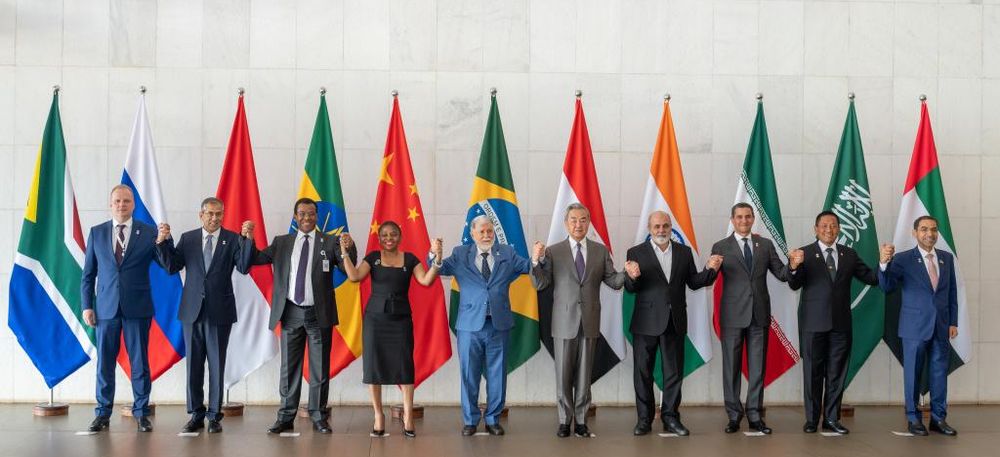
Iran wants BRICS to stop talking and start building. That was the blunt message from Abdolnasser Hemmati, governor of the Central Bank of Iran, when he stood up at the first-ever meeting of BRICS finance ministers and central bank governors, hosted by India in Jaipur earlier this August.
Hemmati’s pitch was simple. He advocated for the creation of a dedicated BRICS financial corridor and links the payment systems of member countries together. He argued that real infrastructure like banks and traders can actually be used to move money across borders, safely, cheaply and without leaning on financial networks controlled from outside the bloc.
He laid out the logic plainly. If BRICS countries hook their national payment systems together and lean more heavily on their own currencies for trade, transactions get faster, costs come down, and the whole system becomes harder to disrupt. For a country like Iran, which has spent years locked out of the SWIFT network and boxed in by US sanctions, more so now more than ever with the war, this becomes a survival strategy.
Hemmati didn’t stop at the pitch. He told the room that Iran has already started doing the homework, through examining the legal and technical groundwork needed to connect payment systems across the bloc, and offered to help draft an actual roadmap rather than wait for someone else to write it.
Iran signed on to BRICS PAY, the bloc’s electronic banking platform, back in 2023, as parliament speaker Mohammad Bagher Qalibaf openly described it as a way to get around SWIFT restrictions. Since formally joining BRICS in 2024 alongside Egypt, Ethiopia and the UAE, Iran’s central bank has kept a seat in the group’s working groups on cross-border payments, national currencies, fintech and even AI and cybersecurity.
The Jaipur meeting also gave Hemmati a stage to push a second long-standing goal: getting Iran into the BRICS-run New Development Bank, founded in 2015 by Brazil, Russia, India, China and South Africa to fund infrastructure and development projects. Hemmati told reporters that Iran’s entry into the bank is close, calling it the "most important result" of BRICS cooperation so far, though the bank itself hasn’t confirmed a timeline. He also said Tehran is chasing bilateral and trilateral currency arrangements with other member states, on top of the multilateral corridor idea.
There’s a harder backdrop to all this. Hemmati made his remarks while referencing the recent US-Israeli military action against Iran, and he framed financial stability as something that can’t really exist without peace and respect for international law.
India’s central bank governor, Sanjay Malhotra, said around the same meetings that BRICS countries are exploring links between their domestic fast-payment systems, and even discussing whether central bank digital currencies could eventually plug into the same network. Officials stress this is still early-stage stuff, more exploration than execution.
That’s really the honest state of play right now. Iran has put a concrete proposal on the table and says it’s willing to do the technical legwork. Other BRICS members are nodding along and running their own parallel discussions. But nobody has signed off on an actual system yet, and building shared payment infrastructure across countries with very different banking rules, currencies and politics is a slow, messy process.
Still, the direction is clear enough. Iran has made "de-dollarize BRICS trade" one of its main foreign economic policy goals, and after the Jaipur meeting, it now has something the bloc can point to as a starting proposal, rather than just another talking point about moving away from the dollar.
Written by:
*Dr Iqbal Survé
Past chairman of the BRICS Business Council and co-chairman of the BRICS Media Forum and the BRNN
*Chloe Maluleke
Associate at BRICS+ Consulting Group
Russia & Middle East Specialist
**The Views expressed do not necessarily reflect the views of Independent Media or IOL.
** MORE ARTICLES ON OUR WEBSITE https://bricscg.com/ (https://bricscg.com/)
** Follow @ (https://x.com/brics_daily)brics_daily (https://x.com/brics_daily)on Twitter for daily BRICS+ updates and instagram @brics_daily (https://www.instagram.com/brics_daily?igsh=bmhvbTd0YzA4a2wx)