
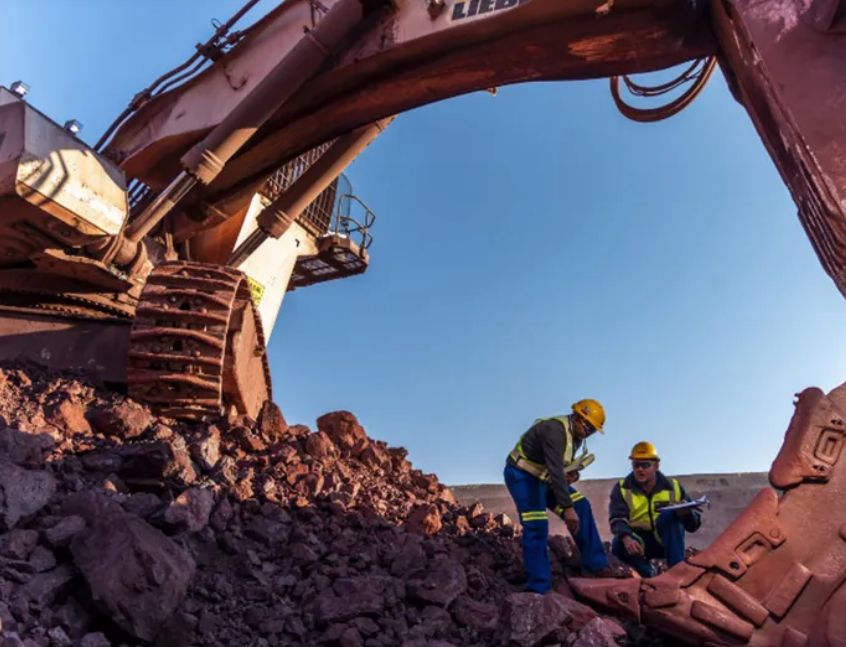
Mining expert David van Wyk estimates there are now more than 34,000 irregular miners operating across South Africa, and the damage they leave behind has moved well beyond the mining sector itself into the electricity grid, water pipes, roads and building foundations of the country’s economic capital.
When the Underground Threatens What’s Above It
The scale of the physical risk is what distinguishes South Africa’s crisis from ordinary informal mining elsewhere. City Power, Johannesburg’s electricity utility, has warned that underground excavation has compromised ground stability to the point where substations, transformers, pylons and transmission towers are now at risk of collapse. Zama zamas routinely strip copper cabling for resale, damage water pipes and tunnel beneath roads. In Denver, near the city centre, a factory owner told AFP he watched illegal miners emerging from a hole roughly 100 metres from his building each week, and pointed to cracks in his premises he attributes to underground blasting. Many of the old shafts are also flooded with acidic mine water, a legacy contamination problem that van Wyk says is now contributing directly to sinkholes forming across the reef. This is not a remote rural phenomenon; it is happening beneath the foundations of Africa’s financial hub.
The state’s response has been military rather than administrative. President Cyril Ramaphosa authorised Operation Prosper, deploying roughly 2,200 troops across five provinces this year at a reported cost of R80 million, following an earlier 2023 operation that used 3,300 personnel to temporarily clear 6,500 miners from sites, activity that resumed within weeks once troops withdrew. The most extreme episode came at Stilfontein in late 2024, where authorities blockaded the Buffelsfontein shaft and cut off food and water to force out an estimated 4,000 to 4,500 miners underground, some of whom reportedly survived on a mixture of toothpaste and toilet paper. The operation drew condemnation from labour federations and humanitarian groups, and courts eventually intervened to order aid access, yet by most accounts, digging elsewhere along the reef barely paused.
A Problem South Africa Didn’t Invent
South Africa’s predicament sits inside a much larger global pattern, and the comparisons are instructive. Ghana has spent a decade battling its own version of this crisis, known locally as galamsey, where illegal small-scale gold mining has poisoned major rivers, including the Pra and Ankobra, threatening water supplies for millions and prompting repeated states of emergency and military crackdowns of its own, with strikingly similar results: enforcement clears sites temporarily, then diggers return once attention moves on. Peru offers a different model worth weighing. Facing a comparably entrenched informal mining sector in regions like Madre de Dios, Peru has experimented with formalisation schemes such as REINFO, registering informal miners under regulated conditions rather than relying solely on force. The results have been imperfect and contested, but they reflect a recognition that when an activity is driven by mass unemployment and lucrative black-market pricing, zama zama gold reportedly fetches around $160 a gram, extraordinary income in a country where joblessness sits near 40%, raids alone rarely address the underlying economics.
Infrastructure Damage Doesn’t Wait for Policy Debates
That economic logic is precisely why enforcement-only strategies keep failing on South Africa’s gold reef. A Bench Marks Foundation research paper has even found that some licensed mining companies have been buying gold from zama zama networks, suggesting the illicit and formal economies are more entangled than official rhetoric admits. Meanwhile, the physical toll compounds daily: every additional shaft dug beneath Johannesburg’s substations and pipelines is infrastructure damage that will eventually cost the city more to repair than any single military operation costs to run. South Africa does not need to look far for the two paths available to it, Ghana’s cycle of temporary crackdowns, or Peru’s harder, slower attempt at formalisation. The ground beneath Johannesburg is not going to wait patiently for the country to decide which one it prefers.
Written by:
*Dr Iqbal Survé
Past chairman of the BRICS Business Council and co-chairman of the BRICS Media Forum and the BRNN
*Sesona Mdlokovana
Associate at BRICS+ Consulting Group
Africa Specialist
**The Views expressed do not necessarily reflect the views of Independent Media or IOL.
** MORE ARTICLES ON OUR WEBSITE https://bricscg.com/ (https://bricscg.com/)
** Follow @ (https://x.com/brics_daily)brics_daily (https://x.com/brics_daily)on Twitter for daily BRICS+ updates and instagram @brics_daily (https://www.instagram.com/brics_daily?igsh=bmhvbTd0YzA4a2wx)