
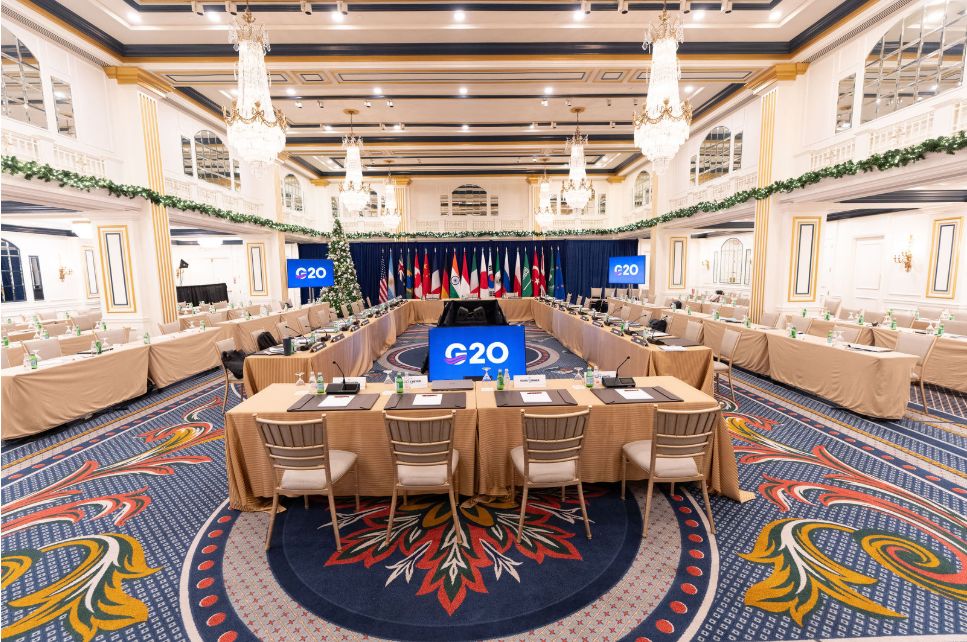
For the first time since its full-scale invasion of Ukraine in 2022, Russia sat at the G20 table in person this past week, when Finance Minister Anton Siluanov appeared at a ministerial meeting hosted by the United States. The moment, engineered by the Trump administration, has reignited a debate that has simmered since the war began: should Russia be welcomed back into the world’s premier forum for economic cooperation, or does its presence there reward aggression?
A Deliberate Shift in Course
Since 2022, Moscow had largely been sidelined from G20 leader-level engagement, with Vladimir Putin skipping the 2023 New Delhi and 2024 Rio de Janeiro summits and sending Foreign Minister Sergey Lavrov in his place. That pattern shifted this year. The United States, as 2026 host, has planned a leaders’ summit for December 14–15 in Miami, and the White House confirmed plans to extend an invitation to Putin himself, even as officials expressed doubt he would attend given an outstanding International Criminal Court arrest warrant. Russia’s own Foreign Ministry has said it received an invitation "at the highest level," though it has stopped short of confirming Putin’s attendance.
The finance ministers’ meeting was a preview of what’s to come. Siluanov’s appearance was not announced by Washington in advance, and it visibly unsettled several delegations. Polish Finance Minister Andrzej Domanski told reporters he found Russia’s presence unwelcome, arguing that Moscow could not be trusted in negotiations and remained the aggressor in the war. Tensions escalated further over the meeting’s traditional group photo: European officials reportedly insisted Siluanov be excluded, and when he was left out, US Treasury Secretary Scott Bessent posed for a solo photo with him instead as a workaround.
Why Washington Is Pushing This
The Trump administration’s rationale reflects a broader, long-standing position. Trump has argued for years that isolating Russia diplomatically was counterproductive, previously suggesting Russia should be readmitted to the G7 and claiming its exclusion helped set the stage for the 2022 invasion. Supporters of this approach argue that sustained dialogue, even with an adversarial power, keeps channels open for eventual peace negotiations and prevents Russia from retreating entirely into economic and diplomatic alignment with China. Notably, Siluanov’s bilateral meeting with Bessent reportedly touched on the administration’s broader peace framework for Ukraine, suggesting the G20 engagement is being used, at least partly, as a diplomatic pressure valve.
Why Critics Are Alarmed
Opponents see this differently. For Ukraine’s allies in Europe, normalising Russia’s presence at high-profile multilateral gatherings risks legitimising the war and undercutting the isolation strategy the West has pursued for years through sanctions and diplomatic exclusion. The photo dispute, though symbolic, captured this tension precisely: a seemingly minor procedural question became a proxy battle over whether Russia should be treated as an ordinary participant in the international order or as a pariah state.
What It Signals Geopolitically
Russia’s re-entry into G20 proceedings, even in this limited and contested form, illustrates a wider recalibration in how great powers are approaching the post-invasion world. It suggests Washington is increasingly willing to prioritize direct engagement over collective Western unity on isolation, a shift that could strain the transatlantic alliance if it continues into December’s leaders’ summit. It also raises questions about the G20’s function: is it primarily an economic coordination body where adversaries must still talk, or a venue where membership implicitly confers legitimacy on a government’s conduct?
Whatever happens in Miami, the finance ministers’ meeting has already demonstrated that Russia’s reintegration into international forums will not be quiet or uncontested. Every appearance, every photo, and every handshake is likely to be scrutinised as a barometer of where the war, and the world’s tolerance for Moscow, currently stand.
Written by:
*Dr Iqbal Survé
Past chairman of the BRICS Business Council and co-chairman of the BRICS Media Forum and the BRNN
*Chloe Maluleke
Associate at BRICS+ Consulting Group
Russia & Middle East Specialist
**The Views expressed do not necessarily reflect the views of Independent Media or IOL.
** MORE ARTICLES ON OUR WEBSITE https://bricscg.com/ (https://bricscg.com/)
** Follow @ (https://x.com/brics_daily)brics_daily (https://x.com/brics_daily)on Twitter for daily BRICS+ updates and instagram @brics_daily (https://www.instagram.com/brics_daily?igsh=bmhvbTd0YzA4a2wx)