

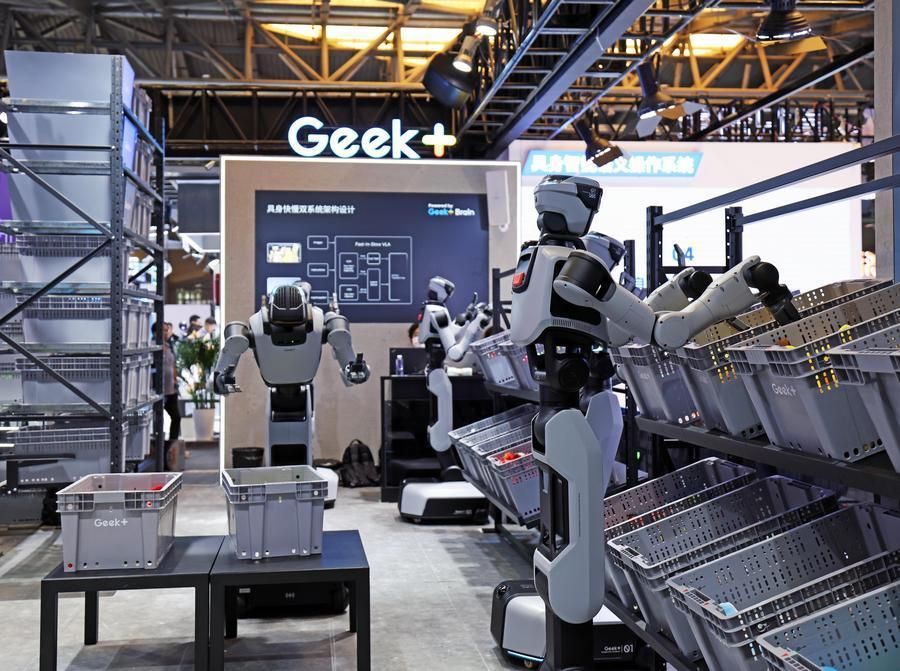
Artificial intelligence, robotics, sensors, cloud platforms and connected supply chains are increasingly being brought together into one operating environment. The result is a factory that can adjust to changing conditions rather than simply follow instructions.
This shift is already moving beyond experimentation. Physical AI is also pushing automation into more unpredictable environments, with robots using sensors, computer vision and AI to navigate spaces and respond to changing conditions. That could be particularly important in warehouses and logistics, where flexibility is often as valuable as speed.
The World Economic Forum’s Intelligent Industrial Operations Outlook 2026 describes a transition from traditional automation towards intelligent, connected and increasingly autonomous systems. Its Global Lighthouse Network now covers hundreds of advanced manufacturing sites using technologies including AI, robotics, cloud computing and big data.
The significance is not the technology itself. It is what manufacturers can do with it.
AI can analyse production data to identify patterns that may be difficult for people to see in real time. A system can detect an emerging quality problem, anticipate equipment failure, adjust production schedules or help forecast demand. Instead of responding after a disruption occurs, companies can increasingly prepare for it while there is still time to act.
That changes the economics of manufacturing. Downtime becomes something to predict rather than simply endure. Inventory can be managed with better information. Production can become more flexible when demand changes. Quality control can move closer to the point where problems begin.
The same principle is extending beyond the factory floor.
Modern production depends on networks of suppliers, ports, warehouses, transport operators and distributors spread across countries. A delay in one part of that network can quickly affect another. AI systems are now being developed to identify disruptions, assess alternatives and, within defined limits, coordinate responses across different parts of the supply chain.
But intelligent manufacturing has a major weakness: intelligence depends on information.
A company cannot expect AI to solve fragmented operations if its underlying data is incomplete, inconsistent or trapped in separate systems. The World Economic Forum has increasingly emphasised the importance of trusted data, integrated processes, governance and clear human oversight as companies move towards more autonomous supply chains.
This makes digital transformation less about buying the newest technology and more about rebuilding how an organisation works. It also brings cybersecurity, accountability and data governance into the centre of strategy.
There is also a workforce question. The rise of intelligent factories does not necessarily mean that humans disappear from production. Instead, repetitive and data-heavy tasks can increasingly be handled by machines, while workers move towards roles requiring technical knowledge, judgement, problem-solving and oversight.
The World Economic Forum’s 2026 Human-Machine Collaboration Framework estimates that three in four industrial jobs are expected to evolve, while around 40% of future industrial skills could be new or emerging. That suggests training will become a central part of industrial competitiveness.
For developing economies, the transformation presents both an opportunity and a challenge. Countries seeking to strengthen manufacturing cannot focus only on attracting factories. They also need digital infrastructure, technical skills, reliable energy, data capabilities and policies that allow businesses to adopt advanced technologies without leaving workers behind.
The future factory, therefore, will not simply be one where robots work faster. It will be one where machines, data and people operate as a connected system.
Manufacturing is moving from automation towards adaptability. The companies and economies that can turn technology into faster learning, better decisions and more resilient supply chains will be better positioned for an increasingly unpredictable global economy.
Written by:
*Chloe Maluleke
Associate at BRICS+ Consulting Group
Russia & Middle East Specialist
**The Views expressed do not necessarily reflect the views of Independent Media or IOL.
** MORE ARTICLES ON OUR WEBSITE https://bricscg.com/ (https://bricscg.com/)
** Follow @ (https://x.com/brics_daily)brics_daily (https://x.com/brics_daily)on Twitter for daily BRICS+ updates and instagram @brics_daily (https://www.instagram.com/brics_daily?igsh=bmhvbTd0YzA4a2wx)







