

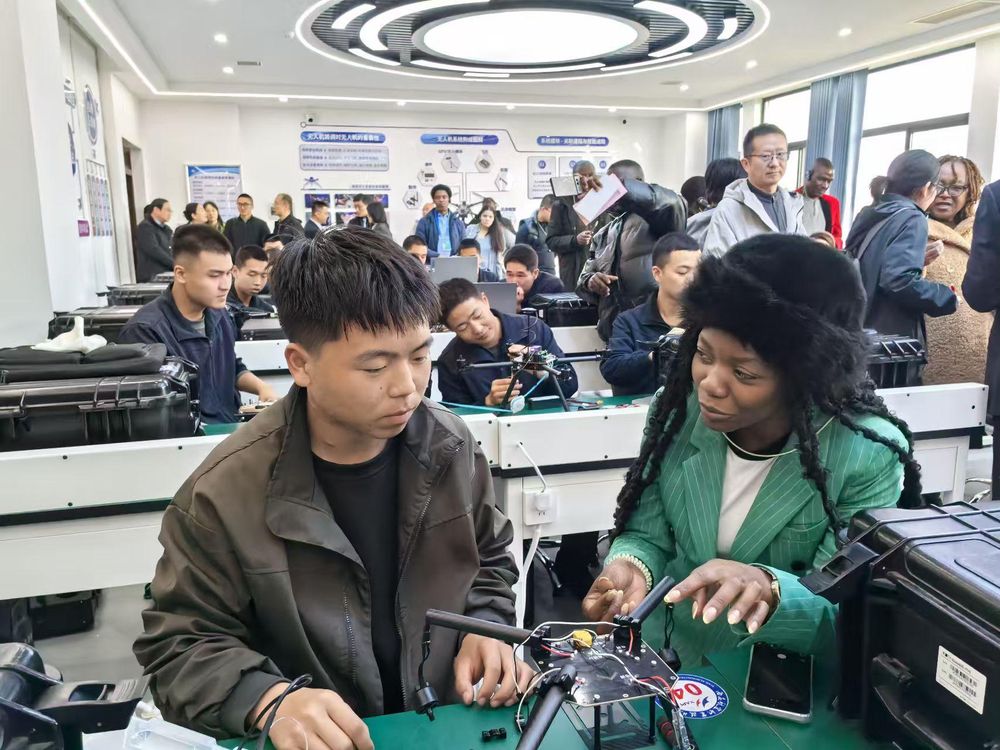
Xi’an, Shaanxi: A trainee from Laos with no drone experience put her first aircraft into a guardrail. The polytechnic that trained her treats that as the point.
Li Ping had never flown an unmanned aircraft and did not know the technical vocabulary when she arrived at the UAV training facility at the Xi’an Aeronautical Polytechnic Institute, home to an enrolled student body exceeding 16,000.
Ping’s first exercise ended with the drone out of control and slamming into a perimeter guardrail. She faced no penalty. At the polytechnic, a crash is a case study.
Trainees pull the telemetry, examine the damage, work out whether the cause was overcorrection or turbulence, and return to the flight pad. Dong Yuying, a lecturer who led media from 10 African countries on a tour of the facility, said this approach is deliberate: students learn discipline by repeating each flight phase until it becomes instinct.
The UAV syllabus runs from pre-flight checklists and battery management to hovering, coordinated yaw, pitch and roll, and emergency manual override and precision landing.
Ping went on to master manual flight and automated waypoint photography, and can now deploy drones independently for surveying. In contrast to conventional academic study, vocational technical education works from a distinct, pragmatic philosophy.
“The workshop is the classroom, and the workwear and tools are the textbooks,” Dong said.
A workshop for partner countries
Her training sits within the Qinling Workshop, a cooperation platform set up in Shaanxi for Belt and Road partner countries. It works in two directions: bringing overseas students to Chinese aviation bases, and exporting standards, hardware and curricula to build training centres abroad.
One example is the Jingshi Academy, set up with the Lao Babasa Technical College. Liu Zhiwu, the college’s deputy dean, said the aim is not to donate equipment and leave. The programme describes its philosophy as “hematopoietic cooperation”, meaning building a partner country’s ability to produce its own skills.
For Laos, with its mountainous terrain and large agricultural and forestry sector, the applications are practical: multispectral imaging and crop spraying in hard-to-reach areas, monitoring rivers and reserves without risky expeditions, and rapid damage assessment after disasters.
Graduates are expected to go home and teach others. The institution also offers 49 higher vocational programmes centered around aviation manufacturing, materials, automotive, and maintenance engineering.
Why the A320Students train on a range of aircraft, including the A320 from South Africa and the J-7, rather than on a single platform. Gong Xiatao, the college’s vice-president, said the Airbus A320 was chosen because of cooperation agreements with South Africa and because it is so widely used commercially, giving students exposure to a real-world aircraft environment.
“The A320 is one of the world’s most widely operated commercial aircraft,” Gong said. “Training on this model allows students to work with authentic aviation systems, including complex mechanical, electrical, and cabin components.”
Jobs at the end of it Liu Zhiwu, the college’s deputy dean, said the curriculum is developed with government bodies and aviation enterprises.
According to the college’s figures, which he cited, more than 60% of graduates each year secure contracts with large and medium-sized state-owned enterprises, and over 70% enter aviation, aerospace and advanced equipment maintenance.
“Alumni, often reach senior technician roles within a few years. “For South Africa, the case for vocational training, the model offers a contrast with classroom-heavy approaches: real tools, real aircraft, and failure as part of the curriculum.
* Peters is in Fuzhou for the conference