
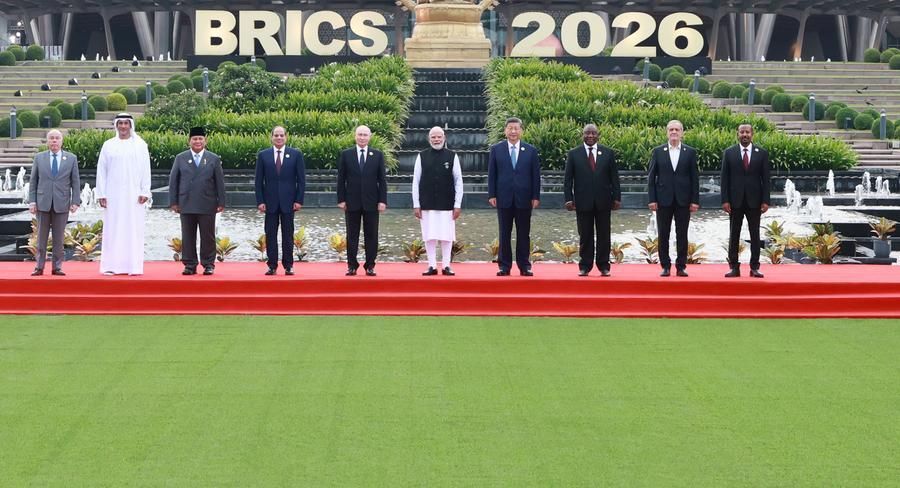
The 18th BRICS Summit in New Delhi has reinforced a reality that is becoming increasingly difficult to ignore: the global economy is changing, and the Global South is no longer content to remain a passive participant in decisions largely shaped elsewhere.
Meeting in New Delhi on 12 and 13 September, the 11 BRICS members adopted the New Delhi Declaration, setting out a broad programme covering trade, investment, finance, technology, artificial intelligence, development, energy, food security and reform of global institutions. More than a statement of political intent, the summit reflected a growing effort to build practical forms of cooperation between emerging economies.
For India, which held the BRICS presidency in 2026, the central message was that developing countries must move from being rule-takers to becoming rule-shapers. Prime Minister Narendra Modi described the task as transforming a “pyramid of privilege” into a “platform of partnership”. That language captures the wider direction of BRICS: greater representation is important, but representation must ultimately translate into economic influence.
Trade and finance move closer to the centre
One of the most significant areas of the summit was financial cooperation. BRICS did not announce a common currency, despite years of speculation around the possibility. Instead, members continued to pursue a more practical approach: increasing the use of national currencies in trade, improving cross-border payment systems and exploring greater interoperability between digital payment infrastructure.
The New Delhi Declaration also supports greater local-currency financing through the New Development Bank and further work towards a BRICS investment platform. India proposed a BRICS Risk Lab at Gujarat International Finance Tec-City, while members supported continued work on improving the environment for investment between BRICS economies.
This is important because reducing dependence on a single financial system does not require the immediate creation of a new global currency. It can begin with something more practical: making it easier for businesses in emerging markets to trade, invest and settle payments in their own currencies.
For companies operating across Africa, Asia, the Middle East and Latin America, this could eventually reduce transaction costs and create new routes for trade and investment.
A more connected Global South economy
The summit also placed industrial development and technology firmly on the BRICS agenda.
Chinese President Xi Jinping called for deeper economic cooperation and proposed initiatives covering artificial intelligence, trade and industrial development. China also put forward the creation of a BRICS AI Open Source Zone, reflecting the growing importance of technological cooperation among developing economies.
The significance extends beyond AI itself. Developing countries face a familiar challenge: many possess natural resources, growing consumer markets and young populations, but remain positioned lower down global value chains. Cooperation in technology, manufacturing, digital infrastructure and industrial capacity could help BRICS economies move further from the export of raw materials towards higher-value production.
This has particular relevance for Africa.
For South Africa and the wider continent, BRICS cooperation is increasingly connected to the question of whether African economies can use their relationships with major emerging markets to accelerate industrialisation, infrastructure development and value addition.
President Cyril Ramaphosa has consistently placed these issues at the centre of South Africa’s BRICS participation, including stronger intra-BRICS trade and investment, industrialisation, infrastructure and economic opportunities linked to the African Continental Free Trade Area.
The opportunity is substantial. Africa has critical minerals, agricultural potential, renewable-energy resources and one of the world’s fastest-growing consumer populations. The strategic question is how those advantages can be connected to capital, technology, infrastructure and markets.
BRICS can become one of the platforms through which those connections are built.
Reforming the global economic system
The political dimension of the summit was equally important. BRICS leaders again called for reform of global governance institutions, including the United Nations Security Council and the international financial architecture, with greater representation for developing countries.
Russian President Vladimir Putin argued for stronger representation for Asia, Africa and Latin America in global decision-making, while Xi Jinping called for a more equitable international order.
This is not simply about gaining seats at existing institutions. It reflects a broader argument that the distribution of economic power has changed faster than the structures governing the international system.
BRICS countries increasingly want their economic weight reflected in the rules governing trade, finance, development and international decision-making.
A broader political voice
The New Delhi Declaration also addressed major international conflicts, including the situation in West Asia and Palestine, while calling for diplomacy, sovereignty and peaceful resolution of disputes. BRICS members opposed the forced displacement of Palestinians and called for greater diplomatic efforts to prevent conflict.
The significance here is that BRICS is increasingly providing a forum through which countries of the Global South can articulate positions on international affairs outside traditional Western-led political groupings.
Its members do not share identical foreign policies. Nor do they need to.
The strength of BRICS lies partly in the fact that countries with different political systems, economic structures and strategic interests can still identify areas of shared interest — particularly development, sovereignty, trade, investment and a more representative international system.
What comes next
The New Delhi Summit therefore marks another step in BRICS’ evolution.
The bloc began as a platform connecting major emerging economies. Its expansion has transformed it into a much broader Global South grouping, bringing together major economies from Africa, Asia, the Middle East and Latin America.
The next phase will be about implementation.
The real measure of BRICS will increasingly be found in the deals that are concluded, the infrastructure that is financed, the payment systems that become usable, the investment that crosses borders, the technology that is shared and the industries that are built.
For Africa, this is where the opportunity becomes particularly significant.
BRICS can provide access to markets, capital, technology and strategic partnerships, but African countries will need to negotiate from a position of economic strategy — using AfCFTA, regional economic communities and national industrial policies to ensure that greater South-South trade translates into local production, employment and value addition.
The New Delhi Summit has therefore moved the BRICS conversation beyond the question of whether the group represents a challenge to the existing global order.
A more important question is emerging: can BRICS help build a global economy in which developing countries have greater capacity to determine what they produce, where they trade, how they finance development and how they participate in the industries of the future?
The direction taken in New Delhi suggests that this is increasingly the ambition.
For the Global South, that shift from representation to economic agency may ultimately prove to be BRICS’ most important contribution.
Written by:
*Dr Iqbal Survé
Past chairman of the BRICS Business Council and co-chairman of the BRICS Media Forum and the BRNN
*Chloe Maluleke
Associate at BRICS+ Consulting Group
Russia & Middle East Specialist
**The Views expressed do not necessarily reflect the views of Independent Media or IOL.
** MORE ARTICLES ON OUR WEBSITE https://bricscg.com/ (https://bricscg.com/)
** Follow @ (https://x.com/brics_daily)brics_daily (https://x.com/brics_daily)on Twitter for daily BRICS+ updates and instagram @brics_daily (https://www.instagram.com/brics_daily?igsh=bmhvbTd0YzA4a2wx)