

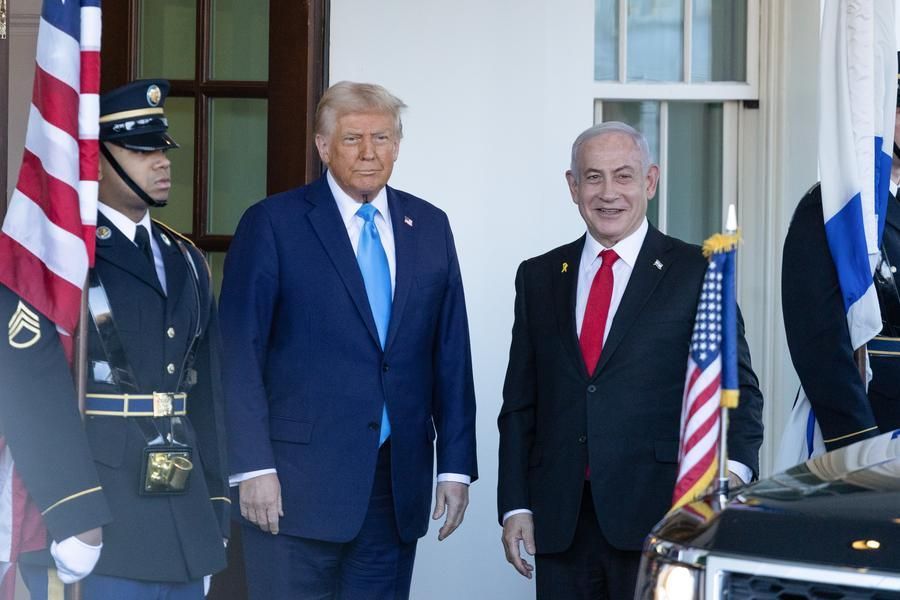
At some point this week, the leader of the free world picked up the phone and called the Prime Minister of Israel "effing crazy." He confirmed it publicly. On a podcast. Without much embarrassment. This is where we are.
Trump’s blowup with Benjamin Netanyahu is not just a piece of diplomatic gossip. It is a window into one of the most complicated, consequential, and increasingly unstable relationships in international politics and right now, that relationship is under more strain than at any point in recent memory.
Here is what happened. Netanyahu threatened to bomb the Dahieh district of Beirut, one of the most densely populated areas near the Lebanese capital. He framed it as a response to Hezbollah ceasefire violations. Iran responded by threatening to suspend nuclear talks with the United States entirely. Iranian officials warned of retaliation in the Strait of Hormuz.
Trump called him. He told him what he thought of that decision, in language that left little room for interpretation. Netanyahu turned the troops around. Trump posted on Truth Social calling it a productive conversation. Netanyahu told CNBC that the two leaders "always find a way to work things out, as great friends."
Then Israel kept striking southern Lebanon "as planned" and Netanyahu’s own Defence Minister publicly denied there was any ceasefire in Lebanon at all. That is the relationship in miniature. Rage, reassurance, and then business as usual, except business as usual means bombs are still falling.
Netanyahu has been doing this for three decades. He tested Bill Clinton over the Oslo process until Clinton reportedly said he felt like he was negotiating with the Palestinians on Netanyahu’s behalf. He blindsided Barack Obama by scheduling a speech to Congress on Iran policy, without telling the White House it was happening. He accused Joe Biden of withholding weapons while Biden was actively defending Israel at the United Nations. Every American president has eventually arrived at the same place: genuine frustration with a man who is simultaneously indispensable and impossible.
What makes the current moment different is the context. Trump is not simply annoyed about a speech or a settlement announcement. He is trying to close a deal, a real one, with real stakes. The Iran ceasefire is fragile. The Strait of Hormuz, through which roughly a fifth of the world’s oil flows, is still not fully open. A nuclear framework that could define the region for a generation is sitting on the table and Netanyahu’s military campaign in Lebanon keeps threatening to blow the whole thing up, because Iran has made one thing consistently clear: no deal while Israel strikes Lebanese territory.
The divergence between American and Israeli objectives is now impossible to ignore. Trump wants an exit with a deal he can brand as historic, an end to a war that is deeply unpopular at home, a Strait reopened and oil prices stabilised before the November midterms. Netanyahu wants Hezbollah degraded, Gaza subdued, and Iran weakened, and he is prepared to let diplomacy wait while the military objectives are pursued. These are not the same goals. They are not even compatible goals at the current pace.
A Pew Research poll released in April found that 60% of Americans now hold a negative view of Israel. Before the Hamas war in 2023, that figure was 42%. Senior figures within Trump’s own conservative base have publicly said the Iran war was started due to Israeli pressure. Joe Kent, who ran the National Counterterrorism Center, resigned in March making exactly that argument. The political cost of appearing too closely aligned with Netanyahu is no longer theoretical for Trump. It is measurable and growing.
Which is why some analysts believe the "effing crazy" phone call served a dual purpose. Yes, Trump was genuinely angry, but the public confirmation of that anger, on a podcast, on the record, also creates something Trump increasingly needs: visible distance.
Netanyahu, for his part, is unbothered. He has survived worse. He survived Clinton’s frustration, Obama’s contempt, Biden’s exhaustion, and several Israeli corruption trials. He has governed Israel for longer than any prime minister in the country’s history, repeatedly by making himself appear indispensable in moments of national crisis. A war on multiple fronts is not a threat to his political survival. It is the condition in which he is most comfortable.
"He is a very difficult negotiator," said Natan Sachs of the Middle East Institute. "Not just in terms of being tough, but in terms of being very suspicious."
That suspicion runs deep. Netanyahu does not fully trust American commitments. He does not believe that any deal Washington makes with Tehran will hold long enough to matter. And he is operating on a different timeline to Trump entirely, one measured not in midterm cycles but in what he sees as an existential confrontation with Iran that has been building for forty years.
The question is whether Trump, faced with an ally who keeps undermining his most important diplomatic initiative, will eventually decide the relationship has costs that outweigh the benefits. Every previous president stopped short of that conclusion. The special relationship endured every fight, every slight, every betrayal of trust.
But Trump is not a conventional president, and the stakes this time, a nuclear deal, a global shipping corridor, an ongoing war, are not conventional stakes.
"I would not rule that out," said Sachs, when asked whether the relationship could fundamentally change. "The president has changed his mind about many people in the past." Netanyahu called Trump the greatest friend Israel has ever had in the White House. Friends, apparently, are allowed to call each other crazy. The question is what happens when one of them stops laughing it off.
Written by:
*Dr Iqbal Survé
Past chairman of the BRICS Business Council and co-chairman of the BRICS Media Forum and the BRNN
*Chloe Maluleke
Associate at BRICS+ Consulting Group
Russia & Middle East Specialist
**The Views expressed do not necessarily reflect the views of Independent Media or IOL.
** MORE ARTICLES ON OUR WEBSITE https://bricscg.com/ (https://bricscg.com/)
** Follow @ (https://x.com/brics_daily)brics_daily (https://x.com/brics_daily)on Twitter for daily BRICS+ updates and instagram @brics_daily (https://www.instagram.com/brics_daily?igsh=bmhvbTd0YzA4a2wx)