
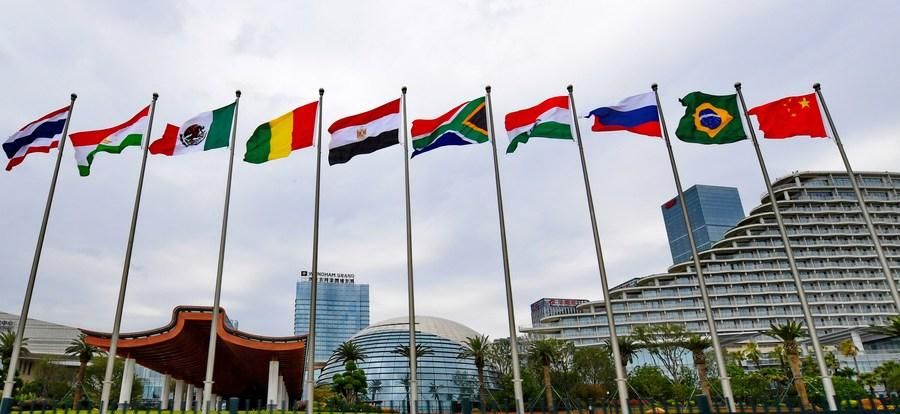
For decades, the G7 was treated as shorthand for the world’s economic centre of gravity. That assumption is now being challenged by the numbers. According to recent figures cited by BRICS officials and reported across several outlets, the combined economic output of the BRICS bloc, measured in purchasing power parity terms, has moved ahead of the G7’s. It’s not a brand-new development; BRICS first edged past the G7 on this measure back between 2019-2020, depending on which dataset you look at. But the gap has kept widening, and it’s now being talked about openly by BRICS leaders as proof that the world is shifting towards a more multipolar order.
Russian President Vladimir Putin recently pointed to IMF figures putting BRICS’ combined GDP, adjusted for purchasing power, at around $77 trillion, against roughly $57 trillion for the G7. Other analysts have put BRICS’ share of global GDP on this basis at somewhere between 32% – 35%, compared with the high-20s to low-30s for the G7. Whichever exact figures you use, the trend line is the same: BRICS has been climbing steadily while the G7’s share has been sliding, down from something like 45 per cent of global output in the early 1990s.
A Bigger Voice for the Global South
South Africa’s BRICS sous-sherpa, Ben Joubert, has described the bloc as a consolidated voice for the Global South, pointing to efforts to build stronger policy coordination and bring younger people and academics into government thinking. Russian diplomats have gone further, framing BRICS as a genuine pillar of an emerging multipolar system, and arguing that the group’s differences in politics and economic models shouldn’t stop it working together.
That framing has practical stakes. As China and India in particular keep growing faster than most G7 economies, developing nations have more reason to look at BRICS institutions, its New Development Bank, its summits, its push for trade in local currencies, as an alternative to Western-led financial arrangements. For countries in Africa, Latin America and parts of Asia, a stronger BRICS could mean more options: alternative lenders, alternative trading partners, and more leverage when negotiating with the IMF, the World Bank, or Western governments generally.
For the G7, the message is less about panic and more about adjustment. Its member states are ageing, growing slowly, and no longer command the overwhelming share of global output they once did. That doesn’t mean they’ve lost their influence over global rules and institutions, they still largely set the terms in trade, finance and technology, but it does mean that influence will increasingly need to be negotiated rather than assumed.
What happens next depends less on GDP tables than on what BRICS actually does with its growing weight. Whether it can turn economic scale into working institutions, coordinated positions in bodies like the UN and WTO, and real alternatives to dollar-based finance will decide whether this shift in the numbers becomes a genuine shift in global power, or stays a striking statistic that Western economies quietly out-manoeuvre in practice.
Written by:
*Dr Iqbal Survé
Past chairman of the BRICS Business Council and co-chairman of the BRICS Media Forum and the BRNN
*Chloe Maluleke
Associate at BRICS+ Consulting Group
Russia & Middle East Specialist
**The Views expressed do not necessarily reflect the views of Independent Media or IOL.
** MORE ARTICLES ON OUR WEBSITE https://bricscg.com/ (https://bricscg.com/)
** Follow @ (https://x.com/brics_daily)brics_daily (https://x.com/brics_daily)on Twitter for daily BRICS+ updates and instagram @brics_daily (https://www.instagram.com/brics_daily?igsh=bmhvbTd0YzA4a2wx)