
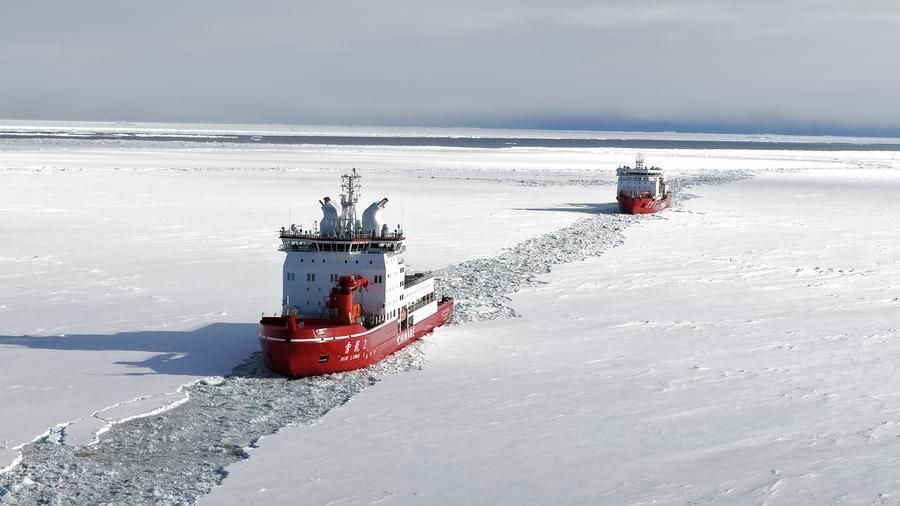
At the 82nd session of the United Nations Economic and Social Commission for Asia and the Pacific in Bangkok, Russian Deputy Foreign Minister Alexander Alimov delivered a pointed message to the region’s policymakers: the Arctic is no longer a frozen frontier, it is a highway, and Russia intends to use it.
"The need for reliable transport and logistics chains becomes especially urgent during periods of turbulence," Alimov said, adding that the Northern Sea Route (NSR) could almost halve transit times between Europe and Asia, giving Russia "a unique competitive advantage" in global shipping. He noted that cargo volumes along the route reached approximately 37 million tons in 2025, up from just 5.4 million tons a decade ago, a near sevenfold increase that signals a structural shift in Arctic commerce rather than a temporary spike.
The Northern Sea Route is a 5,600-kilometre shipping corridor running along Russia’s northern coastline through the Arctic Ocean, connecting European ports to Russia’s Far East and, by extension, to the markets of Asia. The route significantly shortens the journey between western Eurasia and the Asia-Pacific, the distance from Murmansk to Yokohama, for instance, drops from 12,840 nautical miles via the Suez Canal to 5,770 nautical miles via the NSR, translating to roughly 30 to 40 percent less sailing time and substantially reduced fuel consumption.
For Asia-Pacific economies navigating an increasingly volatile global order, that efficiency dividend is not merely commercial, it is strategic. China views the NSR as strategically valuable because it provides a shorter and potentially safer alternative to the Malacca Strait and Suez Canal, reducing dependence on maritime chokepoints vulnerable to geopolitical conflict. Beijing’s interest has moved well beyond statements of intent. Russia and China approved a new action plan to expand NSR shipments following the second meeting of their Sub-Commission for Cooperation in October 2025, aiming to establish a sustainable transport corridor using modern logistics and advanced technologies.
The September 2025 transit of the Istanbul Bridge, a China-linked container vessel from Ningbo to Felixstowe in twenty days marked a further milestone. It was the first liner service, a multi-port shipping operation, to traverse the NSR, demonstrating that the route is maturing from a niche energy corridor into something potentially capable of handling containerised general freight. The energy dimension, however, remains dominant. In 2024 alone, more than 84% of cargo transported along the NSR was oil and gas, a figure that underscores just how central the route is to Russia’s hydrocarbon export strategy as Western markets have progressively closed.
India is also deepening its Arctic engagement. In July 2024, during the Indian Prime Minister’s visit to Moscow, both parties expressed readiness to establish a joint working body on NSR cooperation, and the first meeting of a Russian-Indian working group was held in New Delhi in October of that year, covering polar navigation training and Arctic shipbuilding partnerships. ASEAN economies are paying attention too. Vietnam and Indonesia view Arctic routes as long-term hedges against supply chain volatility, while Gulf and Middle Eastern investors are increasingly attentive to Arctic port, storage, and ship-financing opportunities.
None of this is without complication. Moscow’s 2024 shipping volume target of 80 million tons fell significantly short, with the route logging just under 38 million tons, due in part to the daunting terrain, the need for powerful icebreakers, specialised port infrastructure, and an extensive maritime logistics network. Environmental concerns are also mounting. The infrastructure needed to manage emergencies such as oil spills is practically nonexistent, and ships stuck in ice might wait weeks for assistance, a liability that grows as traffic volumes increase.
But the trajectory is unmistakably upward. Russia’s longer-term target is 270 million tons annually by 2035. Whether or not that figure is achievable, Alimov’s message in Bangkok reflected a broader Kremlin calculation: that in a period of Western-led sanctions pressure and realigning global trade flows, the Arctic is one arena where Russia holds genuine structural leverage. For Southeast Asia and the wider Asia-Pacific, the question is no longer whether the Northern Sea Route matters, it is how quickly they build the partnerships to shape its terms.
Written by:
*Dr Iqbal Survé
Past chairman of the BRICS Business Council and co-chairman of the BRICS Media Forum and the BRNN
*Chloe Maluleke
Associate at BRICS+ Consulting Group
Russia & Middle East Specialist
**The Views expressed do not necessarily reflect the views of Independent Media or IOL.
** MORE ARTICLES ON OUR WEBSITE https://bricscg.com/ (https://bricscg.com/)
** Follow @ (https://x.com/brics_daily)brics_daily (https://x.com/brics_daily)on Twitter for daily BRICS+ updates and instagram @brics_daily (https://www.instagram.com/brics_daily?igsh=bmhvbTd0YzA4a2wx)