
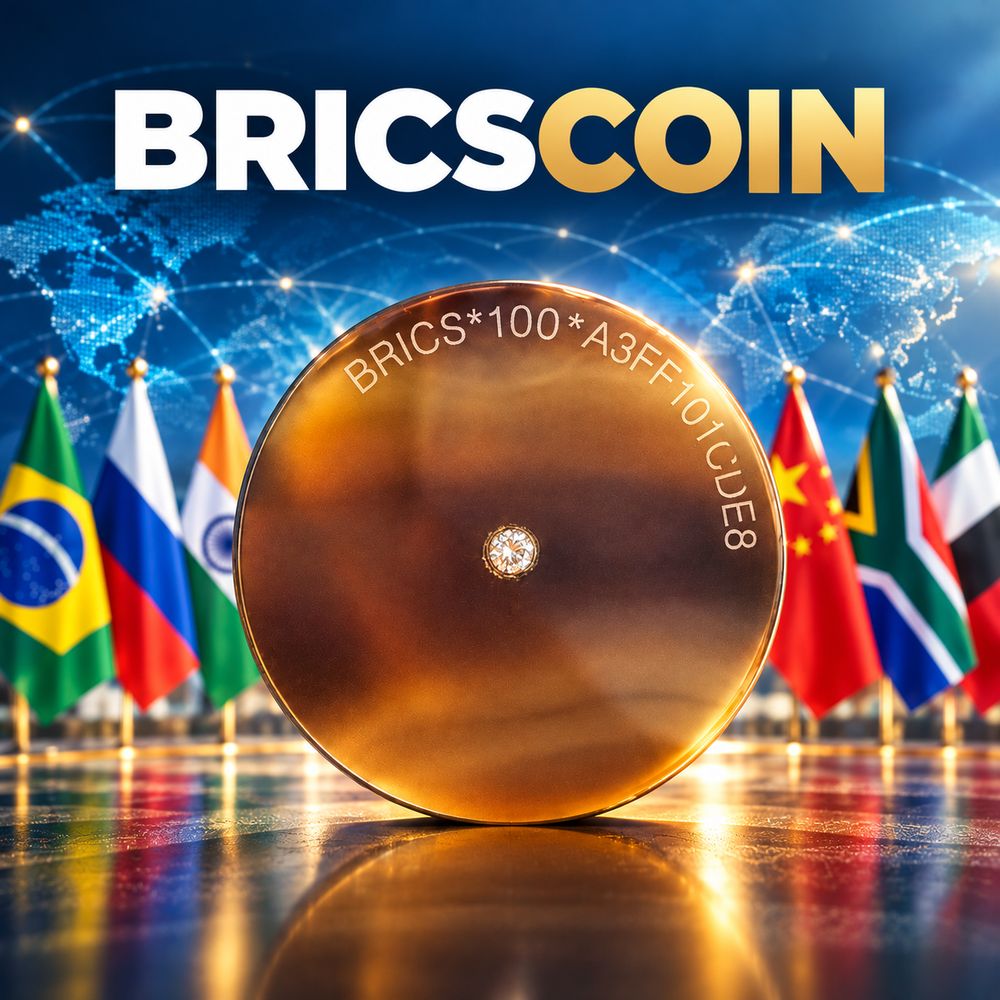
BRICS countries have been looking for a way to settle trade with one another without routing every transaction through the dollar. BRICSCOIN is one concrete answer: a settlement instrument — not a national currency, not a peg to gold, and not a digital token — that central banks would use only to clear trade balances with each other. Part physical, part digital, and issued only by unanimous consent of BRICS central banks — neither a paper currency nor a purely digital one
How a coin comes into being
New BRICSCOIN is minted only by unanimous agreement of an Issuing Council — one representative per founding central bank: Brazil, Russia, India, China, and South Africa. There is no majority override and no algorithmic issuance rule; a single holdout blocks the round. That is a deliberate trade of agility for legitimacy — because no supranational authority exists to compel a reluctant member to accept a distribution it considers unfair, unanimity is the only rule consistent with a system that has no higher court of appeal.
Just as important is what BRICSCOIN doesn’t do. Unlike Keynes’s 1943 bancor (defined with reference to gold) or the IMF’s Special Drawing Right (valued against a currency basket), it carries no anchor, no reserve backing, and no convertibility promise. A formula for “what is one unit worth” is something a member can dispute; BRICSCOIN sidesteps that question rather than answering it.
Physical coins, no printing press: why inflation doesn’t export
Each coin is a certified diamond set into a disk, CT-scanned to capture the unique arrangement of internal inclusions fixed at the moment the stone formed — a physical fingerprint no two stones share, and one that can’t be altered or reproduced. That fingerprint is hashed and registered identically on a ledger held by all five central banks, with no master copy, so any participant can verify a coin is genuine without needing to trust whoever currently holds it. The ledger answers only that one question — is this coin real? — and is never updated when a coin changes hands; settlement is a private, bilateral, off-ledger event, closer to handing over a gold coin than to a blockchain transfer. The diamond’s own market value is trivial next to the coin’s — each BRICSCOIN settles at roughly $1 million, dwarfing the stone inside it — because the diamond isn’t there to back that value, it’s there to make the coin impossible to counterfeit.
That physical, consensus-minted design does something a paper reserve currency structurally can’t: it keeps one member’s domestic monetary policy from leaking into everyone else’s holdings. When a country holds another country’s currency as its settlement asset, it inherits that issuer’s inflation — if the issuer expands its own money supply, every foreign holder’s balance is quietly devalued along with it, whether or not they had any say in the decision. That is how a reserve-currency issuer exports its inflation to everyone holding its money. A BRICSCOIN coin isn’t a claim on any member’s balance sheet, and no member can unilaterally create more of it: new coins require all five signatures, and once minted, a coin is a fixed physical object, not a ledger entry a central bank can inflate away. A coin is not a claim on anything held in custody; it is the settlement instrument itself — the way a gold coin was money in its own right, rather than a claim on money. Neither the importer nor the exporter ever touches a coin: the importer buys BRICSCOIN from its own central bank to pay, and his central bank transfers the coins to the exporter’s central bank, and the exporter’s central bank credits the exporter in local currency — the physical coins move only bank to bank.
Where it could actually start: trade that is already balanced
A settlement instrument with no interest and no peg has one structural weak point: if one side of a trading relationship runs a persistent, one-directional deficit, that country simply runs down its coin holdings, with no market mechanism pulling the imbalance back on its own. Fixing that for a lopsided relationship is a hard problem, better left until the institution has some operating history behind it. The more practical starting point is the opposite kind of relationship: bilateral trade that is already close to balance, where settlement in each direction is roughly self-cancelling, and neither side’s holdings drift very far in either direction. Recent bilateral goods-trade data across the ten full BRICS+ members points to exactly this kind of starting point — and three of the most balanced relationships in the bloc also happen to be three of its largest and most strategically central.
China–Russia is the natural anchor: $245 billion in trade at just a 6% imbalance, proving the mechanism works at real volume, not just as a token gesture. India–South Africa, under $16 billion, is the opposite kind of test — small enough that an early misstep costs little, a sensible place to work out verification and process before scaling up. Brazil–India sits between the two: large, cross-continental, and already discussed as a target for reduced-dollar settlement.
A second tier — and one deliberate contrast
A second tier of near-balanced pairs is worth keeping in view for a later phase, alongside one pair included as a deliberate contrast:
Starting small, on purpose
The case for BRICSCOIN doesn’t rest on launching across the whole bloc simultaneously. It rests on picking corridors where the mechanism can prove itself without much at stake — genuinely balanced trade, moderate volume, willing counterparts — and letting the institution earn trust before it’s asked to handle the harder cases. China–Russia, India–South Africa, and Brazil–India are, on the numbers, exactly that kind of place to begin.
official web site: www.brics-currency.com