
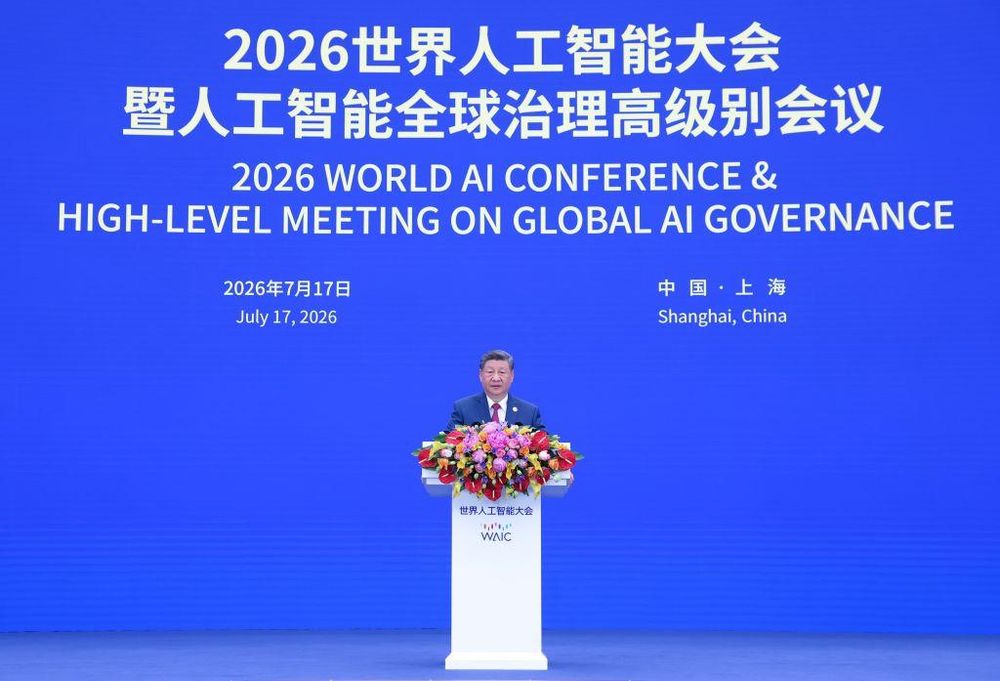
When President Xi Jinping stood before heads of state and international delegates on the banks of the Huangpu River on July 17, 2026, he was not merely opening another technology conference. He was proposing an alternative architecture for how the world governs one of the most consequential technologies of this century.
In his keynote address at the opening of the 2026 World Artificial Intelligence Conference (WAIC) and the High-Level Meeting on Global AI Governance in Shanghai, titled "Joining Hands to Build a Just and Equitable System for Global AI Governance," he laid out a vision that fused domestic industrial ambition with a deliberate, structured appeal to the Global South. A day earlier, twenty-nine countries had already signed the agreement that established the World Artificial Intelligence Cooperation Organization (WAICO), a new Shanghai-headquartered intergovernmental body billed as the world’s first dedicated exclusively to AI cooperation and governance.
Taken together, the speech and the new organisation mark a significant moment in the global contest over who writes the rules for artificial intelligence, and how.
Seventy years on: Framing the moment
Xi opened his address with a historical anchor, invoking the Dartmouth Workshop of 1956, where a small group of American scholars first coined the term "artificial intelligence." Seven decades later, he argued, the world stands at a similarly formative juncture, except this time the stakes are civilisational rather than academic. He then described a period of accelerating technological revolution and industrial transformation, in which intelligent connectivity, human-machine collaboration and cross-sector integration are unleashing what he called enormous power, carrying with it both extraordinary opportunity and serious governance challenges.
He framed the challenge through four unresolved questions that he suggested humanity must now answer together: how to coexist with thinking machines, how to secure decision-making processes in which algorithms play a growing role, how to manage the ethical dilemmas that adaptive technologies generate, and how to ensure AI benefits everyone as the divide between AI-rich and AI-poor nations continues to widen. These are not rhetorical flourishes. They are reflective of a genuine anxiety, shared across capitals from Pretoria to Jakarta to Brasília, that the AI revolution could replicate or worsen the inequities of earlier waves of industrialisation, in which technological leadership concentrated wealth and strategic power in a small number of countries.
Four pillars of China’s governance vision
Xi’s address was structured around four observations that together sketch a comprehensive governance philosophy, and it is worth examining each on its own terms.
The first was a call for openness and win-win cooperation to drive innovation. Xi urged countries to embrace open source development, collaborative research and shared application of AI across traditional industries, emerging sectors and future industries alike, so that the benefits of the technology are not confined to a handful of firms or nations. This is consistent with China’s own domestic trajectory. Beijing has pursued an unusually open-source-heavy AI strategy relative to the United States, with Chinese firms such as DeepSeek, Alibaba’s Qwen and Zhipu AI releasing openly licensed large language models that have found significant uptake among developers in Africa, Southeast Asia and Latin America, precisely the markets least able to afford the compute costs and licensing fees associated with proprietary Western models.
The second pillar concerned risk-awareness and controllability. Xi called for laws, regulations, technological monitoring, early-warning mechanisms and emergency-response systems capable of preventing misuse and ensuring that AI remains, in his words, always under human control. Notably, he also urged countries to jointly oppose the overstretching of national security concepts in the AI field, an unmistakable reference to the export controls, chip restrictions and investment screening measures that the United States and its allies have applied to Chinese AI firms in recent years. This is a governance framework that is simultaneously cautious about AI’s technical risks and pointed in its critique of what Beijing regards as the securitisation of technology policy by Washington.
The third pillar, inclusiveness and mutual learning between civilisations, reflects a theme that has run through Chinese foreign policy discourse for some years, tracing back to the Global Civilization Initiative Xi first proposed in 2023. Applied to AI, the argument is that the values embedded in algorithms should reflect humanity’s shared and diverse ethical traditions rather than the norms of any single civilisation, an implicit rejoinder to concerns that AI systems trained predominantly on Western data and built by Western firms risk encoding a narrow set of cultural assumptions as universal defaults.
The fourth pillar, solidarity and improved global governance, is where the speech turned from principle to institution-building. Xi called for genuine multilateralism, a stronger role for the United Nations, and closer alignment on AI development strategies, governance rules and technical standards, so that a consensus-based global governance framework can be established without delay. He was explicit that this must include capacity-building support for Global South countries, framed not as charity but as a way of preventing what he termed a new historical injustice in AI, a phrase that deliberately echoes the language often used to describe the colonial-era extraction of resources and technology from the developing world.
China’s domestic foundations
Xi did not present these principles in a vacuum. He grounded them in China’s own record, noting that this year marks the beginning of China’s 15th Five-Year Plan, which he said maps out the country’s economic and social development for the next five years and creates opportunities for the wider international community. He pointed to the interplay between an efficient market and a well-functioning government as the basis for China’s AI innovation strategy, and highlighted that the country’s core smart economy industries are now valued at more than one trillion renminbi, roughly 140 billion US dollars at current exchange rates, with intelligent manufacturing cited as a defining feature of what Chinese officials describe as Chinese-style modernisation.
He was careful, too, to stress that this growth has not come at the expense of governance discipline. China, he said, continues to refine its laws, regulations, policies, application norms and ethical principles so that AI development proceeds safely, securely and in a manner that remains, in his own metaphor, a fine steed that gallops with both speed and stability. This balance between rapid deployment and regulatory caution is one that many governments, including South Africa’s own policymakers currently working through the Presidential Artificial Intelligence Industry Masterplan, will recognise as a live and unresolved tension in their own contexts.
From initiative to institution: The birth of WAICO
The most consequential development to emerge from Shanghai was not the speech itself but the institution it endorsed. Since 2023, Xi has been building toward this moment through a sequence of proposals: the Global AI Governance Initiative, a United Nations General Assembly resolution on international cooperation for AI capacity building adopted by consensus, the AI Capacity-Building Action Plan for Good and for All, and the AI Plus International Cooperation Initiative. On 16 July, the day before Xi’s keynote, representatives of twenty-nine countries signed the agreement formally establishing WAICO in Shanghai, with Chinese Foreign Minister Wang Yi signing on behalf of the Chinese government.
The founding membership is a revealing document in itself. It spans Asia, Africa, Latin America and parts of Europe, and includes South Africa, Kenya, Ethiopia, Senegal, Algeria, Cameroon, Congo, Lesotho, Mozambique, alongside Brazil, Indonesia, Malaysia, Pakistan, Kazakhstan, Russia and others. It is, as several international commentators have noted, a membership list that maps closely onto China’s existing network of Belt and Road and BRICS-adjacent partnerships. No G7 country and no major Western AI power joined as a founding member, underscoring that WAICO is positioned less as a universal successor to bodies like the OECD’s AI governance frameworks and more as a Global South-anchored alternative institution, open in principle to all states but built, in its first iteration, on the foundations of China’s existing diplomatic relationships.
South Africa’s participation as a founding member is significant for Pretoria’s own positioning. It places South Africa, alongside Kenya, Rwanda and Nigeria, among the African states best placed to help shape emerging global AI rules at an early stage, rather than simply receiving standards set elsewhere. Given South Africa’s simultaneous roles in BRICS, the G20 and the African Union, its WAICO membership offers a potential channel for aligning continental AI priorities, including those set out in the African Union’s Continental AI Strategy, with the capacity-building resources China has pledged.
United Nations Secretary-General António Guterres attended the signing ceremony and the WAIC opening in person, a detail Chinese state media were quick to highlight as validation of the initiative’s multilateral credentials. In his remarks, Guterres and the other heads of state and government present, including Kazakh President Kassym-Jomart Tokayev, Cambodian Prime Minister Hun Manet and Thai Prime Minister Anutin Charnvirakul, praised China’s contribution to global AI governance and echoed the call for AI benefits to be shared equitably, bridging what Xi described as both the AI divide and the broader North-South development gap.
Concrete commitments, not just principles
What distinguished this year’s WAIC from previous editions was the specificity of the deliverables Xi announced, moving the Global AI Governance Initiative from declaratory principle to measurable commitment. Over the next five years, China will offer developing countries 5,000 training and seminar opportunities in AI. It will establish AI application cooperation centres jointly with the Association of Southeast Asian Nations, the League of Arab States, the African Union, the Community of Latin American and Caribbean States, the Shanghai Cooperation Organisation and BRICS. And it will extend access to MAZU, China’s AI-powered meteorological early-warning system, to thirty countries, a practical application with obvious relevance for African nations grappling with climate volatility and extreme weather events.
These commitments matter because they translate an otherwise abstract governance debate into infrastructure, training pipelines and applied tools that developing economies can use immediately. For a continent such as Africa, where compute infrastructure, cloud capacity and AI talent pipelines remain thin relative to global demand, the offer of structured cooperation centres and training slots addresses a real and frequently cited constraint on AI adoption, even as it raises legitimate questions about dependency, data governance and long-term technological sovereignty that African governments will need to weigh carefully.
A contested vision
It would be incomplete, and inconsistent with the standard of accuracy this analysis aims for, to present China’s framework as universally embraced. Several independent analysts, including researchers writing for the Carnegie Endowment for International Peace and The Diplomat, have observed that WAICO’s membership excludes Western democracies almost entirely and reflects, rather than transcends, existing geopolitical alignments. Critics have also drawn a line from WAICO’s emphasis on state-centred digital cooperation to China’s longstanding advocacy of cyber sovereignty, the principle that governments should retain primary authority over digital governance within their borders, and have questioned whether this framing adequately protects independent oversight and human rights accountability in AI deployment. These are legitimate concerns that deserve to sit alongside the genuine capacity-building value the initiative offers, and any government engaging with WAICO, South Africa included, will need to weigh both dimensions rather than treating the initiative as governance in the abstract.
At the same time, it is equally accurate to note that the existing alternative, a governance landscape shaped overwhelmingly by a small number of American and European technology firms and the regulatory preferences of Washington and Brussels, has itself drawn sustained criticism from Global South governments for offering limited input into rule-making that will nonetheless determine their access to frontier technology. Xi’s framing of AI development as a symphony rather than a solo performance, and his explicit rejection of a governance order in which any single country’s security interests override those of others, speaks directly to that frustration, even if the alternative China is proposing is itself led by a single, powerful state.
Why this matters for the Global South, and for South Africa
For countries like South Africa, positioned simultaneously within BRICS, the G20, the African Union and now WAICO, the choice is rarely a binary one between Western and Chinese-led frameworks. It is instead a question of how to extract the maximum developmental benefit, in training, infrastructure and market access, while retaining enough regulatory independence to set domestic standards on data protection, algorithmic accountability and digital rights that reflect South Africa’s own constitutional and democratic commitments. WAICO’s proposed cooperation centre with the African Union, alongside the training slots and applied tools such as MAZU, represent concrete near-term opportunities. Whether they translate into durable capability rather than continued dependency will depend substantially on how African governments, South Africa’s included, negotiate the terms of engagement.
Conclusion
Xi Jinping’s address in Shanghai, and the WAICO agreement it accompanied, together represent one of the more consequential moves in the still-unsettled contest over global AI governance. China has moved beyond issuing declarations and has now built an institution, backed by concrete financial and technical commitments, designed to appeal directly to the developing world’s frustrations with a technology order it has had little hand in shaping. Whether WAICO becomes a genuinely consequential pillar of global AI governance, comparable in stature to institutions like the World Trade Organization as some commentators have speculated, or remains a more limited platform for South-South technical cooperation, will depend on how effectively it delivers on its training, infrastructure and standard-setting promises over the coming years. For South Africa and its Global South partners, the task now is less about choosing a side than about ensuring that participation in this new architecture strengthens, rather than substitutes for, their own capacity to govern AI on their own terms.