
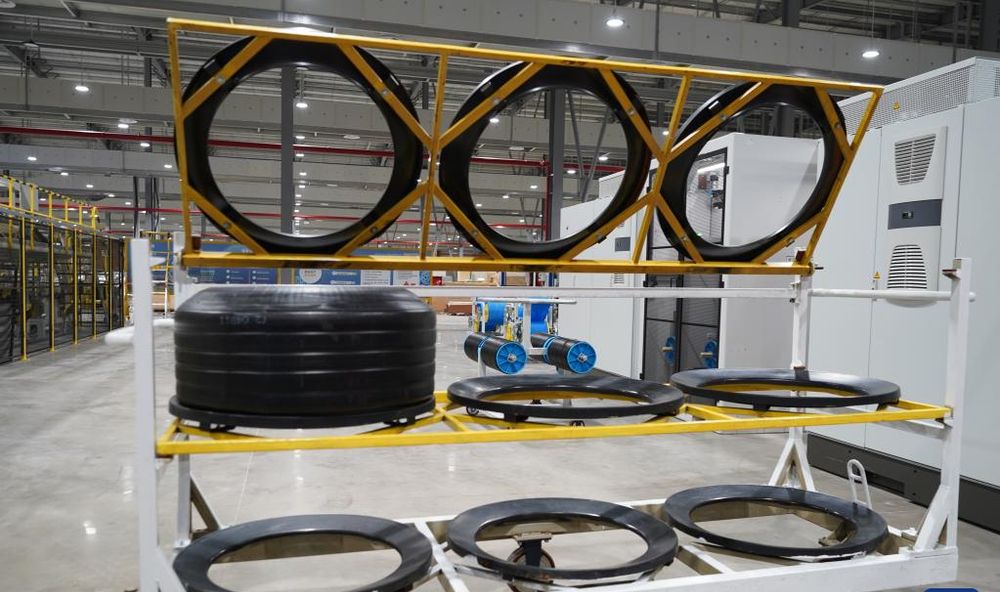
When China National Tire and Rubber Corporation (CNTR) announced a $550 million investment to expand its tyre manufacturing footprint in Alexandria, the headline was notable enough on its own terms: 1.5 million tyres a year, 1,600 new jobs, production starting in 2028. But the more revealing detail is the context in which it sits. CNTR’s commitment is the third major Chinese tyre investment in Egypt in under a year, and together they tell a story that goes well beyond the rubber industry.
In August 2025, Cairo signed a deal with China’s Sailun Group for a $1 billion automotive tyre factory in the Suez Canal Economic Zone. In April 2026, Shandong Linglong Tyre announced plans to invest nearly $2 billion in a facility producing car and heavy truck tyres for export to the Gulf and the United States. Now CNTR, whose portfolio includes a controlling stake in Milan-listed Pirelli and Shanghai-listed Aeolus Tire, with 24 plants across 13 countries, is deepening its Egyptian presence through its Prometeon subsidiary. In little more than twelve months, Chinese tyre manufacturers have committed well over $3.5 billion to a single country. That is not a coincidence. It is a strategy.
To understand why, it helps to set the tyre sector within the broader picture of Chinese investment in Egypt. The Suez Canal Economic Zone alone has attracted over $11.6 billion in investment over the past three and a half years, with Chinese investors accounting for approximately half of that total, according to Waleid Gamal El-Dein, chairman of the SCZone authority. The zone has become a cornerstone of Egypt’s Vision 2030 industrial programme, which explicitly seeks to position the country as a regional manufacturing and export hub. Egyptian Investment Minister Hassan El-Khatib has described the next phase of cooperation with China as one centred on joint production and export-oriented manufacturing — building things in Egypt and selling them to the world, rather than simply transferring ownership of existing assets.
Mostafa Ibrahim, vice chairman of the China committee at the Egyptian Businessmen’s Association, put it plainly: "Some countries invest in Egypt by buying factories, which is an ownership transfer, not a real investment. China comes to build real factories." That distinction carries real weight. Greenfield industrial investment of the kind CNTR, Linglong and Sailun are committing creates supply chains, develops local skills, and generates export capacity that compounds over time. It is a different category of economic partnership from portfolio flows or acquisition activity.
Several forces are converging to make Egypt particularly attractive for this model of investment at this moment. Geography is the most obvious. Egypt’s proximity to the Suez Canal, through which roughly 20,000 vessels pass annually, gives manufacturers sited there access to European, African and Middle Eastern markets at freight costs that are difficult to replicate from East Asia. For tyre manufacturers specifically, whose products are bulky and expensive to ship, proximity to end markets is a meaningful competitive variable.
Trade architecture matters as well. Egypt holds free trade agreements with the European Union, the Common Market for Eastern and Southern Africa, and a range of Arab League partners, giving manufacturers operating within Egyptian special economic zones preferential access to a combined market of well over two billion people. For Chinese companies navigating an increasingly complex global tariff environment, one shaped by US-China trade tensions and the broader reconfiguration of global supply chains, Egypt offers a manufacturing base from which finished goods can reach key markets under more favourable conditions.
Labour economics add a further dimension. Egyptian manufacturing wage costs remain substantially below those in China’s coastal industrial provinces, creating the kind of cost arbitrage that makes greenfield investment viable at scale. The Egyptian government has reinforced this with competitive incentives in its industrial zones: corporate tax rates as low as zero in designated free zones, customs exemptions on inputs, and streamlined profit repatriation rules.
What is emerging, taken together, is something larger than a cluster of individual investment decisions. Egypt is developing the characteristics of a genuine manufacturing export platform — one that connects Chinese industrial capital and production expertise to African, Middle Eastern and European demand through a geography that is almost uniquely well placed to serve all three. The tyre sector is, in this sense, a leading indicator rather than an isolated story. Textile, aluminium, logistics and chemicals investments are following a very similar pattern, each drawn by the same combination of location, incentives, trade access and government commitment.
For Egypt, the opportunity is significant and the direction of travel is clear. The task ahead is ensuring that the infrastructure, regulatory environment and workforce development keep pace with the investment commitments being made, turning a wave of announcements into a durable industrial base that generates lasting value for the Egyptian economy. The factories being built in Alexandria and along the Canal are the beginning of that process. The more interesting story will be what grows around them.
Written by:
*Chloe Maluleke
Associate at BRICS+ Consulting Group
Russia & Middle East Specialist
**The Views expressed do not necessarily reflect the views of Independent Media or IOL.
** MORE ARTICLES ON OUR WEBSITE https://bricscg.com/ (https://bricscg.com/)
** Follow @ (https://x.com/brics_daily)brics_daily (https://x.com/brics_daily)on Twitter for daily BRICS+ updates and instagram @brics_daily (https://www.instagram.com/brics_daily?igsh=bmhvbTd0YzA4a2wx)