

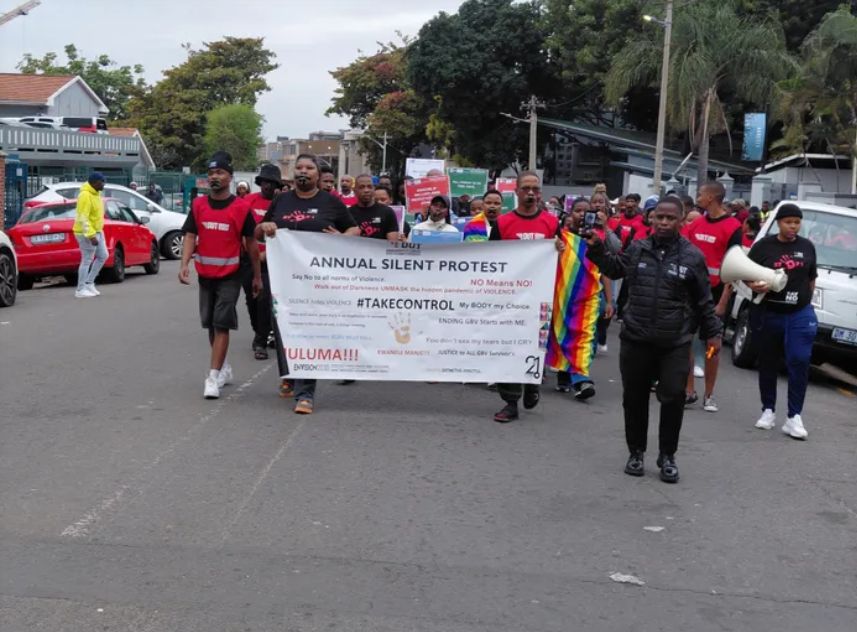
She became the sixth woman whose body has been discovered across the broader Ekurhuleni area in the space of roughly two months. Police are investigating possible links between the cases, but have cautioned that it is too early to say whether a serial killer is responsible.
That distinction matters for the investigation.
But it should not distract from the bigger crisis.
South Africa does not have a shortage of declarations about GBVF. It has a shortage of consequences, protection and urgency.
Six bodies should force a different conversation
The case of 38-year-old Elizabeth "Tsontso" Moselakgomo has intensified public anger.
Moselakgomo, a mother, disappeared after leaving home for a run. Her family later identified her body at the Germiston mortuary. Police have deployed specialised resources to investigate her death alongside the other killings.
The circumstances surrounding the deaths are still being established. It would be irresponsible to declare that the women were killed by the same person before investigators have established that.
But six bodies in a concentrated geographical area demand an extraordinary response.
Police have already deployed multidisciplinary investigators and forensic specialists. One suspect remains in custody in connection with the first body found in July. Investigators are now working to establish whether there are connections between the cases.
The public therefore needs more than reassurance that investigations are under way.
It needs results.
Because for women living in Ekurhuleni, the question is not whether authorities will eventually explain what happened. It is whether the state can prevent the next woman from becoming another case file.
The numbers make the argument even harder to ignore
The Ekurhuleni killings are unfolding against a national crisis.
SAPS recorded 569 women murdered between April and June 2026, alongside 9,201 reported rapes. More than 60% of a sampled group of rape cases occurred at a residence, challenging the idea that violence against women is primarily a danger lurking somewhere outside the home.
The scale is precisely why government classified GBVF as a national disaster in November 2025.
That designation was supposed to allow government to coordinate its response, direct resources towards the crisis and strengthen accountability. Government has also established the National Council on GBVF to coordinate the national response.
But nearly a year into the disaster declaration, frontline organisations are still reporting serious resource problems.
The National Shelter Movement of South Africa says about 90% of the shelters it supports are struggling with funding and other forms of support. These are the institutions women may depend on when they are trying to escape abusive homes, access counselling, obtain legal assistance or protect their children.
That exposes a fundamental contradiction.
If GBVF is a national disaster, the infrastructure protecting its victims cannot be treated as an afterthought.
Cameroon is showing what a more urgent response can look like
South Africa is not alone in confronting femicide.
In Cameroon, more than 120 women have reportedly been killed by intimate partners since the beginning of the year. In response, the government has launched a three-month national campaign targeting femicide, domestic violence, gender inequality and male dominance, with an emphasis on prevention, reporting and prosecution.
Cameroon’s campaign does not solve the problem by itself. Campaigns are only meaningful when they are backed by functioning institutions.
But the comparison raises an important question for South Africa: what does emergency action actually look like when the crisis has already been formally recognised?
It should mean police investigations that move quickly.
It should mean properly funded shelters.
It should mean prosecutors who pursue cases effectively.
It should mean protection orders that are enforced.
It should mean early intervention when patterns of abuse emerge.
And it should mean confronting the attitudes among men that normalise control, entitlement and violence against women.
South Africa needs to stop measuring action by announcements
The most dangerous response now would be another cycle of outrage followed by another announcement.
The state has already acknowledged the problem. President Cyril Ramaphosa has described GBVF as a national disaster, while government has created a statutory National Council and promised stronger policing, survivor support and prevention programmes.
The question is no longer whether government understands the crisis.
The question is whether the system is delivering.
That means publishing measurable targets for investigations, prosecutions, convictions, protection orders, shelter capacity and police responsiveness. It means identifying where resources are failing and fixing those gaps instead of creating another layer of bureaucracy.
And it means men becoming part of the solution, not simply being told to condemn violence after another woman has died.
The women found across Ekurhuleni cannot be reduced to statistics.
Neither can the 569 women murdered in three months.
South Africa has already called GBVF a national disaster.
Now the state has to govern as though it believes its own declaration.
Written by:
*Dr Iqbal Survé
Past chairman of the BRICS Business Council and co-chairman of the BRICS Media Forum and the BRNN
*Sesona Mdlokovana
Associate at BRICS+ Consulting Group
Africa Specialist
**The Views expressed do not necessarily reflect the views of Independent Media or IOL.
** MORE ARTICLES ON OUR WEBSITE https://bricscg.com/ (https://bricscg.com/)
** Follow @ (https://x.com/brics_daily)brics_daily (https://x.com/brics_daily)on Twitter for daily BRICS+ updates and instagram @brics_daily (https://www.instagram.com/brics_daily?igsh=bmhvbTd0YzA4a2wx)