

A country already stretched to breaking point
Start with the citizens the state already fails. Statistics South Africa puts official unemployment in the second quarter at 33.6 percent, with 8.5 million people jobless. Among those aged 15 to 34 the rate is 47.4 percent, which means 5 million young South Africans want work and cannot find it. Include those who have stopped looking and the combined rate reaches 43.8 percent. The formal sector shed 41,000 jobs in the quarter alone.
A government’s first duty is to the people who elect it. Millions of citizens are still waiting for that duty to be honoured, and a state that cannot deliver work or timely documents to them has no business accepting a new open-ended obligation without a plan to fund it. Compassion is a virtue, but it cannot be financed from a treasury and a civil service that are already overdrawn.
An asylum machine that cannot carry the load
On 28 September Home Affairs instructed every refugee reception office to accept all applicants. Within days its senior official warned the department was "going to be overwhelmed by the numbers" and said longer hours and more staff would have to be considered. A department only now considering capacity was not ready for a directive already in force.
The system it is loading is already broken. The Refugee Appeals Authority holds roughly 161,000 cases. Of these, 70,976 are active and 90,024 involve appellants whose whereabouts are unknown. The ringfenced backlog stood at 133,582 in 2021 and has not gone away. In the past year Home Affairs approved 1,934 claims and rejected 7,392, so barely one decision in five was a yes. The Authority has also received 2,733 judicial reviews in its backlog project. Nationwide there are five reception offices, and Gqeberha has three officers who can manage perhaps 15 new applications a day. That is fewer than 4,000 files a year.
Even the state’s knowledge is thin. Stats SA concedes that migration surveillance systems have failed to count migrants accurately. A government that cannot say how many people are in the country cannot say how many it can serve.
The restrictions the Court struck down were never a coherent policy. They were rationing. Pretoria managed scarcity by locking the gate instead of funding the building. The lock is gone and the scarcity remains.
The disillusioned citizen
Then there is the South African in the same queue. She waits for an ID, a passport or a permit in offices that fail her routinely. She is told the state lacks money and staff, then learns it has found an obligation and a deadline for a new category of applicant.
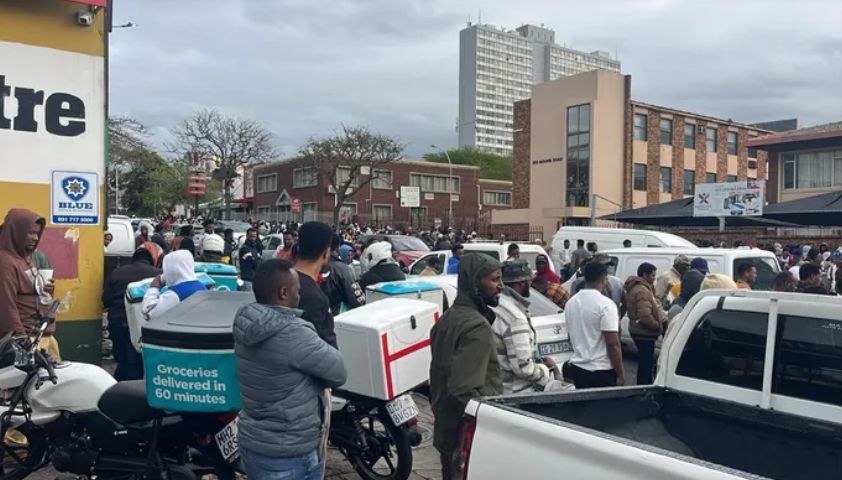
Anti-illegal immigration groups such as Operation Dudula and March and March have gathered outside reception centres, and their support reflects a real sentiment. Citizens believe their government has stopped listening. A democracy that answers that frustration with a directive reaching most citizens through press reports, with no costing, no capacity plan and no public explanation, deepens the distrust it should be repairing.
The only door
South Africa offers few lawful routes for low and semi-skilled work seekers from the region, so asylum has become the only door. A Section 22 permit carries the right to work and study and is renewable while a claim crawls through appeals. The Appeals Authority’s chairperson has described the process as clogged by opportunistic claims, and the 90,000 untraceable appellants suggest many treat the permit as a residence document.
That is incentive design, and South Africans carry the cost. The genuine refugee, say a Congolese mother with a credible fear of persecution, now waits behind people with no such claim. A reform meant to widen her access may narrow it. Germany roughly tripled its migration agency’s staff after 2015 and still needed years to clear the pile, with an economy more than ten times South Africa’s and single-digit unemployment.
The Constitution promises a fair process, not an endless permit lottery. A right that dies in a queue protects no one, least of all the citizens whose trust the state is spending. The Court has done its part. Now Pretoria must show it can govern.
Written by:
*Sesona Mdlokovana
Associate at BRICS+ Consulting Group
Africa Specialist
**The views expressed do not necessarily reflect the views of IOL.
** MORE ARTICLES ON OUR WEBSITE https://bricscg.com/
** Follow @brics_daily on Twitter for daily BRICS+ updates and instagram @brics_daily







