

A movement that found its language
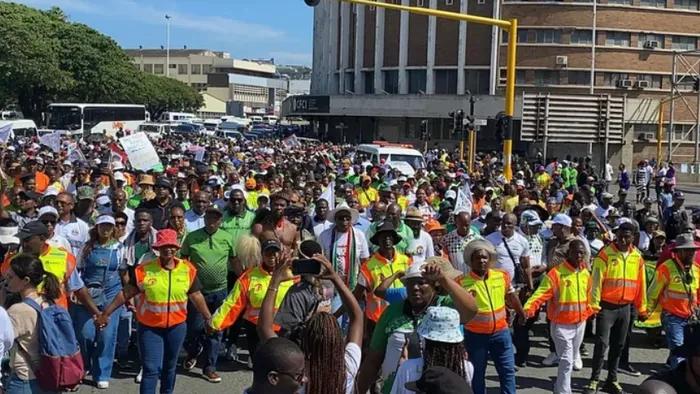
March and March’s leader, Jacinta Ngobese-Zuma, along with her supporters, made no attempt to temper the rhetoric condemning undocumented foreigners’ access to public services, and this includes healthcare. This is not simply fringe politics. It is reflective of a deliberate and increasingly sophisticated repositioning of xenophobia as a governance concern.
There has been a significant effort aimed at reframing Afrophobia as an effort to restore law and order, with a visible shift from using derogatory terms to the legalese of "illegal alien" and "undocumented immigrants." This new language is not accidental. It is employed to disarm potential critics of xenophobia. What we are witnessing is the mainstreaming of exclusionary politics behind the respectability of policy language, and Wednesday’s march is its latest performance.
Operation Dudula and the cost of vigilante politics
Operation Dudula, whose name translates to "force out" in isiZulu, was established in Soweto and has since spread across the country, gaining traction by blaming South Africa’s porous borders and the presence of migrants for the country’s social ills. For a movement that emerged from the economic dislocation of the COVID-19 era, the trajectory has been swift and troubling.
The human cost of this trajectory is not one that is abstract. On 31 July, a one-year-old Malawian boy died after Operation Dudula blocked him from accessing treatment at two local government clinics in Alexandra because the family did not have a South African identity card. A child died, and the Economic Freedom Fighters have since lodged a murder charge. This is not border policy. This is the consequence of allowing vigilante nationalism to operate without any adequate state resistance.
In November 2025, Judge Leicester Adams of the Johannesburg High Court interdicted Operation Dudula and its leaders from intimidating, harassing, or assaulting individuals that are identified as non-citizens, and from publishing any statements on social media that constitute hate speech. The court’s intervention was necessary, but the fact that litigation had to travel as far as it did before meaningful accountability arrived tells its own story about the state’s reluctance to act.
ActionSA and the vacuum argument
ActionSA’s leader Herman Mashaba justified his party’s participation in the Durban march by citing a vacuum left by a government "too slow to act," and he framed the protest as responsible civic pressure rather than political opportunism. This argument is deserving of scrutiny. There is a difference between demanding functional immigration administration and marching alongside a group that has been judicially confirmed to have perpetrated intimidation and hate speech. The vacuum Mashaba describes is 100% real. The company he keeps to fill it is a choice.
Comparisons with other democracies are instructive here. For example, in Italy, anti-immigration sentiment also found institutional expression, with the government passing successive restrictive legislation that drew condemnation from the European Court of Human Rights. What those cases show is that channelling public frustration toward immigrant communities does not reduce unemployment or improve service delivery. It generates political momentum while the structural failures it purports to address remain entirely intact.
The Governance questions nobody is marching about
South Africa’s unemployment rate sits above 30 percent. Load-shedding has cost the economy hundreds of billions of rands over the past 10 years. The public health system is severely under-resourced, under-staffed, and under-maintained. Rather than holding failing government officials to account, anti-migrant groups prefer to intimidate the most vulnerable, when questions about corrupt companies robbing the public health sector, critical vacancies left unfilled, and dangerous health infrastructure are left unaddressed.
The scapegoating of migrants distracts from systemic governance failures, including corruption, austerity, and inefficiency, that truly strain public resources. It is a useful distraction, and some political parties have become expert at deploying it.
What legitimate immigration reform actually requires
None of this is to suggest that South Africa is not facing genuine migration governance challenges. The Department of Home Affairs has been chronically under-capacitated for years, and border management is still inconsistent. These are real administrative failures that warrant serious policy attention. But the solution is not mass deportation marches. It is institutional investment, regional cooperation frameworks under SADC, and a public conversation honest enough to hold the state accountable for its own failures before redirecting public anger toward those with the least power to respond.
Wednesday’s demonstration in Durban was less a policy statement than a reflection of how thoroughly the political establishment has failed to address the legitimate anxieties driving it. The streets are speaking. The question is whether the right problems are being named.
Written by:
*Sesona Mdlokovana
Associate at BRICS+ Consulting Group
Africa Specialist
**The Views expressed do not necessarily reflect the views of Independent Media or IOL.
** MORE ARTICLES ON OUR WEBSITE https://bricscg.com/ (https://bricscg.com/)
** Follow @ (https://x.com/brics_daily)brics_daily (https://x.com/brics_daily)on Twitter for daily BRICS+ updates and instagram @brics_daily (https://www.instagram.com/brics_daily?igsh=bmhvbTd0YzA4a2wx)