
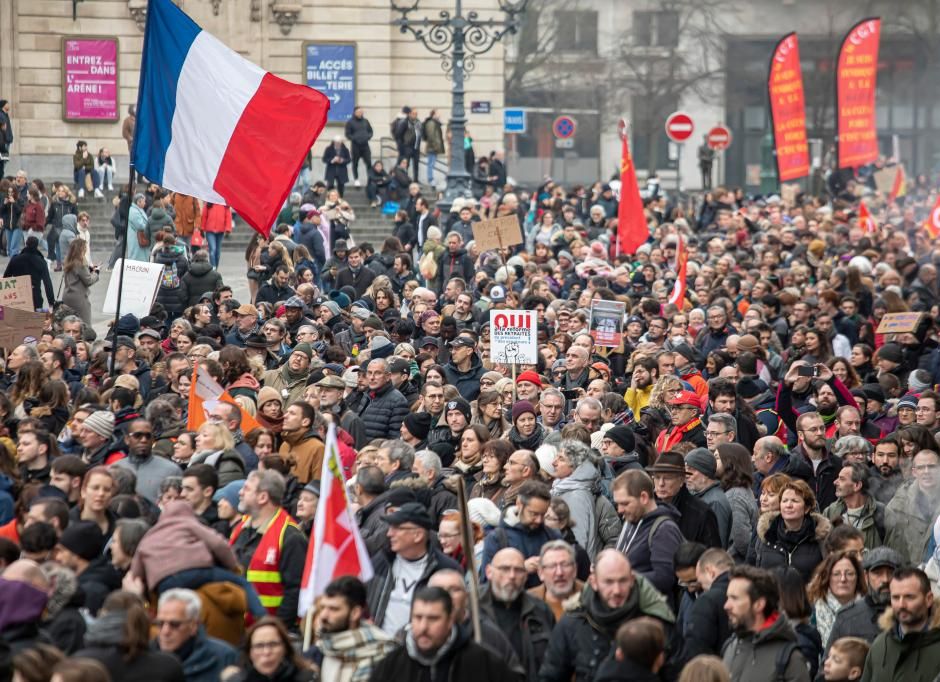
Half a million people marched across France last Saturday. Town halls were set alight, 1,200 were arrested, and two people died. The marchers speak of fuel prices, the cost of living and decaying schools. Yet behind the tear gas lies a harder number: French public debt stands at €3.6 trillion, some 119% of GDP, and ten-year borrowing costs are nudging 5%. The Bank of France’s governor warns of a country "strangled by interest rates".
The usual suspects are pensions, a gridlocked parliament and a generous welfare state. All are guilty. But there is a neglected chapter in this story: the collapse of Françafrique, the web of military, monetary and commercial ties through which France projected power far beyond its means. Its unravelling has not bankrupted France. I will argue, however, that it has narrowed the country’s room for manoeuvre at the worst possible moment.
The sequence is now familiar. French troops left Mali in 2022, Burkina Faso in early 2023 and Niger that December, after coups in all three. Chad, Senegal and Côte d’Ivoire have since followed, leaving Paris with a presence only in Gabon and Djibouti. The CFA franc, long the monetary emblem of the relationship, was reformed: West African states ended the practice of lodging half their reserves with the French Treasury and removed French officials from their central bank’s governance.
Then came the commercial reckoning. Niger’s junta stripped Orano, a company 90% owned by the French state, of operational control of its mines, then nationalised the Somair operation outright. Roughly 1,300 tonnes of uranium concentrate, worth about €250 million, sat stranded. Niger had supplied up to 15% of French uranium needs, and the Imouraren deposit, among the world’s largest, is now beyond Paris’s reach. Russia has openly courted the Nigerien sector.
Sceptics rightly note that Africa accounts for a sliver of French trade. But Françafrique was never really about the trade ledger. It was about leverage: privileged access to strategic inputs, captive markets for French champions, and a military footprint that bought diplomatic weight, including France’s role in drafting UN Security Council resolutions on Africa.
At the margin, that leverage mattered. Africa supplies around 15% of France’s strategic minerals and 11.6% of its oil and gas, according to analysis published in The Conversation. In a world of energy-driven inflation, marginal supply is exactly what sets prices, and prices are what people are marching about. Macron himself, speaking in Nairobi in May, put annual Franco-African trade at around €64 billion, with French investment of some €50 billion supporting a million jobs. These are not sums a government with a 5.4% deficit can casually surrender.
Add the strategic cost. Barkhane consumed a decade of French blood and treasure, and its returns have now been forfeited. Analysts in the Sahel and beyond observe that the vacuum has been filled by Moscow and Beijing, which offer what one study calls a "win-win" alternative. France spent heavily to hold a position that rivals now enjoy for free.
Here lies the real fiscal link. Fitch estimates France needs a cumulative adjustment of about 3.5% of GDP merely to stabilise its debt ratio. The only painless route out of debt is growth, and the government’s own forecasts of 0.6 to 0.9% are anaemic. A country with a shrinking commercial footprint in the world’s youngest, fastest-growing continent has one fewer engine to turn to. By 2050, around 85% of the world’s French speakers will live in Africa. France is abandoning, or being abandoned by, its largest future market.
There is also a political economy dimension. The protests were not about Africa, but they are about a state that can no longer promise anything. Emile Chabal of Edinburgh University has called them the logical outcome of a protest cycle dating back to the yellow vests. A nation watching its once-global role contract feels diminished, and a diminished nation is a harder one to ask for austerity.
An honest case must concede its limits, and they are considerable. The same Conversation analysis notes that Africa accounts for only 1.9% of French foreign trade, and that France’s two largest trading partners in sub-Saharan Africa, Nigeria and South Africa, never hosted a French base. Foreign Policy has described the franc zone as a mere 1% of French trade. A study of West and Central Africa finds that French economic influence is declining far more slowly than its military and political influence.
More damaging still, France’s deficit has domestic causes. The Cour des comptes has accused public spending of running in "free wheel" towards nearly 57% of GDP, in a country that already has the euro zone’s heaviest tax burden. Pension and social-security deficits dominate the arithmetic. And "bankrupt" overstates matters: France’s debt ratio is below Italy’s, Greece’s and America’s, and only 14% of it matures in 2027, as one fund manager has pointed out.
So my conclusion is a qualified one. Françafrique’s collapse did not empty the French treasury; a decade of deficits above 3% did. But the two stories are entwined. A France with healthy finances could have afforded a graceful, negotiated exit from its African commitments, on terms that kept Orano’s mines and Barkhane’s goodwill. A France drowning in debt could not. The retreat was a symptom of exhausted means as much as a cause of it.
The lesson for Paris is humbling. Influence abroad is a luxury good, and it is bought with solvency at home. The marchers in Place de la République are not asking about uranium. But the state that cannot answer them is the same one that can no longer hold Niamey.
Written by:
*Chloe Maluleke
Associate at BRICS+ Consulting Group
Russia & Middle East Specialist
**The Views expressed do not necessarily reflect the views of Independent Media or IOL.
** MORE ARTICLES ON OUR WEBSITE https://bricscg.com/ (https://bricscg.com/)
** Follow @ (https://x.com/brics_daily)brics_daily (https://x.com/brics_daily)on Twitter for daily BRICS+ updates and instagram @brics_daily (https://www.instagram.com/brics_daily?igsh=bmhvbTd0YzA4a2wx)